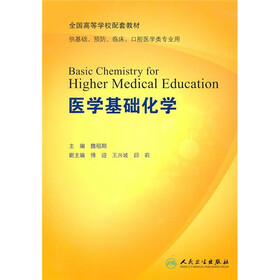
| 《医学基础化学(供基础、预防、临床、口腔医学类专业用)》是全国高等学校配套教材。 |
| Chapter 1 IntrodUctionChapter 1.1 Basic Chemistry and Its Role in Medical Education 1.1.1 Chemistry Is a Central Science ~ 1.1.2 How to Learn Basic Chemistry Well 1.2 The Legal Units of Measurement in Our Country 1.3 The Significant Figures 1.3.1 The Concepts of the Significant Figures 1.3.2 Significant Figures in Calculation 1. Rounding 2. Addition and subtraction 3. Multiplication and division 1.4 Dimensional Analysis 1.5 Disperse System and Mixture Composition Scale 1.5.1 Disperse System and its Classification 1.5.2 The Mixture Composing Sea|es 1. The amount of substance 2. The amount-of-substance concentration 3. The mole fraction and the molality Summary Exercises Supplementary Exercises Chapter 2 Colligative Properties of Dilute Solution 2.1 Vapor Pressure Lowering 2.1.1 The Vapor Pressure of Solution 2.1.2 Vapor Pressure Lowering-Raoults Law 2.2 Boiling Point Elevation and Freezing Point Depression 2.2.1 Boiling Point Elevation 1. The boiling point of solution 2. Boiling point elevation of solution 2.2.2 Freezing Point Depression 1. Freezing point of pure liquid 2. Freezing point depression of solution 2.2.3 Colligative Properties of Electrolyte Dilute Solution 2,3 Osmotic Pressure of Solution 2.3.1 Osmosis and Osmotic Pressure 2.3.2 The Relationship between Osmotic Pressure of Solution and Concentration, Temperature of Solution 2.3.3 Application of Osmotic Pressure in Medicine 1. Osmolarity 2. Isotonic, hypotonic, hypertonic solution 3. Crystalloid osmotic pressure and colloidal osmotic pressure Summary Exercises Supplementary Exercises Chapter 3 Electrolyte Solutions 3.1 Strong Electrolytic Solutions 3.1.1 Strong Electrolyte and Weak Electrolyte 3.1.2 The Main Point of Strong Electrolyte Solutions Theory 3.1.3 Activity and Activity Coefficient 3.2 Dissociation Equilibria of Weak Electrolytes 3.2.1 Ionization Constants for Weak Acids and Weak Bases 3.2.2 Shifting an Acid-Base Equilibrium 1. Influence of concentration on acid-base equilibrium 2. Influence of common ion effect on acid-base equilibrium 3. Influence of salt effect on acid-base equilibrium 3.3 Bmnsted-Lowry Acid-Base Theory 3.3.1 Br~nsted -Lowry Concept of Acid and Base 3.3.2 The Essence of Acid-Base Reaction 3.3.3 Autoionization of Water 1. Autoionization andKw 2. The pH scale 3.3.4 The Relation between Ka and Kb of a Conjugate Acid-Base Pair 3.3.5 Leveling Effect and the Differentiating Effect of Solvent 3.4 Solving Problems Involving Acid-Base Equilibria 3.4.1 StrongAcid and Strong Base 3.4.2 Weak Monoprotic Acid and Weak Monoacid Base 3.4.3 Polyprotic Acid and Polyacid Base 3.4.4 The pH of Amphoteric Substances 1. Solution of negative ions of amphoteric compounds 2. Positive ionic acid and negative ionic base solution 3. Amino acids 3.5 The Lewis Acid-Base and Hard and Soft Acid-Base 3.5.1 The Lewis Acid-Base 3.5.2 Hard and Soft Acids and Bases Principle (HSAB) 3.6 Equilibria of Slightly Soluble Ionic Compounds ~ 3.6.1 The Solubility-Product Constant (Ksp) 1. Solubility and solubility product 2. Solubility product rule: Criteria for precipitation 3.6.2 Shifting the Precipitation Equilibrium 1. Formation of precipitation 2. Fractional precipitation 3. Dissolving slightly soluble ionic compounds 3.6.3 Applications of Precipitation-Dissolution Equilibria 1. Tooth decay and fluoridation 2. Urinary calculus Summary : Exercises Supplementary Exercises Chapter 4 Buffer Solutions 4.1 Buffer Solution and Buffer Process 4.1.1 The Introduction of Buffer Solution and Buffer Process 4.1.2 The Components of a Buffer 4.2 Calculating the pH of a Buffer Solution 4.2.1 Henderson-Hasselbalch Equation 4.2.2 Correction Formula to Calculate the Accurate pH 4.3 Buffer Capacity and Buffer Range 4.3.1 Buffer Capacity 4.3.2 Factors Affecting Buffer Capacity 4.3.3 Effective Buffer Range 4.4 Preparation of a Buffer Solution 4.4.1 How to Prepare a Buffer Solution 4.4.2 Standard Buffer Solutions 4.5 Buffer Systems in Blood Summary Exercises Supplementary Exercises Chapter 5 Colloids 5.1 Colloidal System 5.1.1 Preparation of Colloidal System 1. Dispersion methods 2. Aggregation methods 5.1.2 Surface Properties of Colloidal System 5.2 Sol 5.2.1 Basic Properties of Sols 1. Optical properties of sols 2. Kinetic properties of sols 3. Electrical properties of sol 5.2.2 Structure of Micelle and Stability of Sols …… Chapter 6 Chemical Thermodynamics and Thermochemistry Chapter 7 Rate of Chemical Reaction Chapter 8 Oxidation-Reduction Reaction and Electrode Potential Chapter 9 Structure of the Atom and Periodic Law Chapter 10 Covalent Bond and Intermolecular Forces Chapter 11 Coordination Compounds Chapter 12 Titrimetric Analysis Chapter 13 Ultra-violet Visible Spectrophotometry Chapter 14 Introduction to the Modern Instrumental Analysis Chapter 15 Nuclear Reactions and Their Applications Appendix Appendix 1 Chinese Legal Units of Measurement Appendix 2 Fundamental Physical and Chemical Constants Appendix 3 Tables of Equilibrium Constants Appendix 4 Essencial Thermodynamic Data of Chemical Substances Appendix 5 Standard Reduction Potentials, evalues, at 298.15 K (25℃) Appendix 6 Greek Letters Answers to Selected Exercises Index Name, Atomic Number and Relative Atomic Weight of Elements Periodic Table of the Elements |


 内容加载中,请稍后...







商品评论(0条)