DID YOU KNOW?
Despite numerous attempts by linguistic researchers, Japanese has not been proven yet to be related to any other living language. One theory links it to the group of Altaic languages (such as Mongolian), another one singles out a Ryukyuan-Japanese language family which according to some is a sub branch of the Altaic family, but according to others the result of a cross-over between an Altaic language (like Mongolian) and an Austronesian language (like Malay).
THE JAPANESE WRITING SYSTEM
Written Japanese is actually a combination of three different scripts.
The first, kanji, consists of ideographs (symbols that each represent a concept, idea or thing as well as pronunciation, rather than a word or set of words) borrowed from Chinese, eg 本 (hon) for ‘book’, 娘 (mu·su·me) for ‘daughter’ and 日本語 (ni·hon·go) for ‘Japanese language’.
The other two scripts, hiragana and katakana, are syllabic, that is, each character represents a syllable. Hiragana is used to represent particles and grammatical endings particular to Japanese and are placed alongside the kanji – one single Japanese word can contain both scripts. There are 46 basic hiragana characters each representing a particular syllable. They can be combined to represent over 100 different syllables. Each hiragana character also has a katakana equivalent. Katakana are used to represent recent borrowings from other languages, especially English, and foreign names.
Japanese is usually written vertically and from right to left. However, occasionally it’s written horizontally like English, especially when the text incudes numbers, Romanised Japanese (ie written in the roman alphabet), or English.
MYTHS ABOUT JAPANESE
The Japanese word a·ri·ga·to (‘thank you’) comes from the Portuguese ‘obrigado’
Trade with Portugal in the 16th century has led to the inclusion of some Portuguese loanwords in Japanese, but a·ri·ga·to is not one of them, despite appearances. An version of this word existed well and truly in Japanese before the Portuguese came on the scene.
As dialects are spoken in Japan, it’s useless learning Japanese to make yourself understood when visiting the country.
The language spoken in Tokyo serves as the standard language throughout the country and is used in broadcasting and education (whether the latter is in Japan or overseas).
SAY IT IN JAPANESE!
Hello/Hi. こんにちは。 kon·ni·chi·wa
Goodbye. さようなら。 sa·yō·na·ra
Yes. はい。 hai
No. いいえ。 i·e
I’m from Australia.
オーストラリアから来ました。
ō·sto·ra·rya ka·ra ki·mash·ta
I think I've had one too many.
ちょっと飲みすぎました。
chot·to no·mi·su·gi·mash·ta
Say cheese!
ハイ、チーズ!
hai, chi·zu
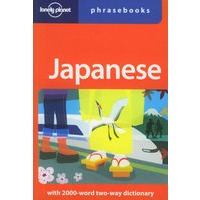
Order the freshest fugu, survive a karaoke session and know how deep to bow. Go beyond the shrines, sushi and subway and discover Japan through its language and people. |
 内容加载中,请稍后...




商品评论(0条)