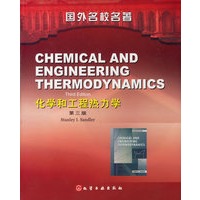
| STANLEY I.SANDLER earned the B.Ch.E.degree in 1962 from the City College of New Y0rk.and the Ph.D.in chemical engineering from the University of Minnesota in 1966.He was then a National Science Foundation Postdoctoral Fellow at the Institute for Molecular Physics at the University of Maryland for the 1966-67 academic year.He joined the faculty of the University of Delaware in 1967 as all assistant professor,and was promoted to associate professor in 1970.professor in 1973 and Henry Belin du Pont Professor of Chemical Engineering in 1982.He was department chairman from 1 982 to 1986.He currently is also professor of chemistry and biochemistry at the University of Delaware and founding director of its Center for Molecular and Engineering Thermodynamics.He has been a visiting professor at Imperial College(London),the Technical University of Berlin.the University of Queensland(Australia)and the University of California.Berkeley.
In addition to this book.Professor Sandier is the author of 225 research papers and a monograph,and he is the editor of a book on thermodynamic modeling and five conference proceedings.Among his many awards and honors are a Faculty Scholar Award(1971)from the Camille and Henry Dreyfus Foundation,a Research Fellow-ship(1980)and US.Senior Scientist Award(1988)from the Alexander von Humboldt Foundation(Germany),the 3M Chemical Engineering Lectureship Award (1988)from the American Society for Engineering Education,the Professional Progress(1984)and Warren K.Lewis Awards(1996)from the American Institute of Chemical Engineers,the E.V Murphree Award(1996)from the American Chemical Society, the Rossini Lectureship Award(1 997)from the International Union of Pure and Applied Chemistry, and election to the US.National Academy of Engineering |
| NOTATION CHAPTER 1 INITODUCTION 1.1 The Central Problems of Thermodynamics 1.2 A System of Units 1.3 The Equilibrium State 1.4 Pressure, Temperature, and Equilibrium 1.5 Heat, Work, and the Conservation of Energy 1.6 Specification of the Equilibrium State; Intensive and Extensive Variables; Equation of State 1.7 A Summary of Important Experimental Observations 1.8 A Comment on the Development of Thermodynamics Problems CHAPTER 2 CONSERVATION OF MASS AND ENERGY 2.1 A General Balance Equation and Conserved Quantities 2.2 Conservation of Mass 2.3 Conservation of Energy 2.4 The Thermodynamic Properties of Matter 2.5 Applications of the Mass and Energy Balances 2.6 Conservation of Momentum 2.7 The Microscopic Equations of Change for Thermodynamics and Fluid Mechanics Problems CHAPTER 3 ENTROPY: AND ADDITIONAL BALANCE EQUATION 3.1 Entropy: A New Concept 3.2 The Entropy Balance and Reversibility 3.3 Heat, Work, Engines, and Reversibility 3.4 Entropy Changes of Matter 3.5 Applications of the Entropy Balance 3.6 Liquefaction …… CHAPTER 4 THE THERMODYNAMIC PROPERTIES OF REAL SUBSTANCES CHAPTER 5 EQUILIBRIUM AND STABILITY IN ONE-COMPONENT SYSTEMS CHAPTER 6 THE THERMODYNAMICS OF MULTICOMPONENT MIXTURES CHAPTER 7 THE ESTIMATION OF THE GIBBS FREE ENERGY AND FUGACITY OF A COMPONENT IN A MIXTURE CHAPTER 8 PHASE EQUILIBRIUM IN MIXTURES CHAPTER 9 CHEMICAL EQUILIBRIUM AND THE BALANCE EQUATIONS FOR CHEMICALLY REACTIONG SYSTEMS APPENDIXES |

 内容加载中,请稍后...





商品评论(0条)