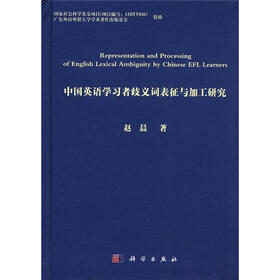
| 《中国英语学习者歧义词表征与加工研究》目前的研究主要探讨母语的词汇歧义消解过程,二语习得者的词汇歧义消解过程还没有得到应有的重视;另外,按照理论语言学的解释,歧义词应该包括同形异义词(homograph)、同音异义词(homop}lone)和多义词(polvsems)。多义词有可分为隐喻性多义词和转喻性多义词。目前的研究讨论了同形异义词和同音异义词的歧义消除,很少提及多义词的歧义消除。当然这也是本书着重解决的问题。《中国英语学习者歧义词表征与加工研究》从词汇语义表征形成与发展的角度,探讨了中国英语学习者在词汇表征建构的不同阶段、词汇多义不同纬度(三种歧义词)的通达特征。它由十章组成。除了第一章的“导言”和第十章的“结论”以外,其他八章为本书的主体。 |
| 前言 Abstract Chapter 1 Introduction 1.1 Research Orientation 1.2 Definition of Lexical Ambiguity 1.3 Rationale for the Study 1.4 Research Questions Chapter 2 Previous Studies of Lexical Ambiguity Resolution: General Issues 2.1 Introduction 2.2 Meaning Representation 2.2.1 Hierarchical Network Models 2.2.2 Activation Spreading Models 2.2.3 Distributed Memory Model 2.3 Word Recognition and Lexical Access 2.3.1 The Search Model 2.3.2 The Logogen Model 2.3.3 The Cohort Model 2.3.4 Factors Influencing Lexical Access 2.4 Semantic Priming 2.5 Second Language Lexicon 2.6 Summary Chapter 3 Previous Studies of Lexical Ambiguity Resolution: Theoretical Models and Empirical Evidence 3.1 Introduction 3.2 Previous Studies of Homonymy Processing in L1 3.2.1 Fodor's Modularity Hypothesis 3.2.2 Five Models of Homonymy Processing in L1 3.3 Previous Studies of Suppression Mechanism in Homonymy Processing 3.4 Previous Studies of Homonymy Processing in L2 3.5 Previous Studies of Polysemy Processing in L1 3.5.1 Representation of Polysemous Words 3.5.2 Previous Studies of Polysemy Effects 3.5.3 Processing of Polysemy in L1 3.6 Previous Studies of Polysemy Processing in L2 3.7 Comments on the Previous Studies of Lexical Ambiguity Resolution 3.8 Summary Chapter 4 Previous Studies of Lexical Ambiguity Resolution: Experimental Tasks 4.1 Introduction 4.2 Experimental Techniques 4.2.1 Ambiguity Detection Method 4.2.2 Processing Complexity Tasks 4.2.3 Priming Paradigm 4.3 The Nature of Sentential Context 4.4 The SOA Conditions 4.5 Comments on the Experimental Tasks 4.6 Summary Chapter 5 Research Questions and Hypotheses 5.1 Introduction 5.2 Linguistic and Psycholinguistic Models Related to the Present Study 5.2.1 Ambiguous Words in Mind: Linguistic Models 5.2.2 Disambiguation of Lexical Ambiguity: Psycholinguistic Models 5.3 Research Questions 5.4 Hypotheses 5.5 Experimental Design and Predictions 5.5.1 Experiment One 5.5.2 Experiment Two 5.5.3 Experiment Three 5.6 Summary Chapter 6 Experiment One: Selecting Contextually Appropriate Meanings 6.1 Introduction 6.2 Preparatory Studies 6.2.1 Preparatory Study Ⅰ 6.2.2 Preparatory Study Ⅱ 6.2,3 Preparatory Study Ⅲ 6.3 Experiment One 6.3.1 Hypothesis, Design and Predictions 6.3.2 Participants 6.3.3 Materials 6.3.4 Procedure 6.3.5 Results 6.3.6 Discussion 6.4 Summary Chapter 7 Experiment Two: Suppressing Contextually Inappropriate Meanings 7.1 Introduction 7.2 Experiment Two 7.2.1 Hypothesis, Design and Predictions 7.2.2 Participants 7.2.3 Material 7.2.4 Procedure 7.2.5 Results 7.2.6 Discussion 7.3 Summary Chapter 8 Experiment Three: Representation of English Lexical Ambiguity 8.1 Introduction 8.2 Experiment Three 8.2.1 Hypothesis, Design and Predictions 8.2.2 Participants 8.2.3 Materials 8.2.4 Procedure 8.2.5 Results 8.2.6 Discussion 8.3 Summary Chapter 9 General Discussions 9.1 Introduction 9.2 Discussion of Lexical Ambiguity Resolution Theories 9.2.1 L2 Processing of Homographs: The Ordered-Access Model 9.2.2 L2 Processing of Metonymic Polysemy: Specified, Not Underspecified 9.2.3 Comparison of the Processing of Different Ambiguous Words 9.3 L2 Lexical Ambiguity Resolution and Reading Comprehension 9.4 Summary Chapter 10 Conclusions 10.1 Introduction 10.2 Conclusions 10.2.1 Conclusions about the Experiments 10.2.2 A Unified Picture for L2 Resolution of Lexical Ambiguity 10.3 Limitations and Suggestions for Future Studies 10.3.1 Limitations 10.3.2 Suggestions for Future Studies 10.4 Implications 10.4.1 Theoretical Implications 10.4.2 Pedagogical Implications 10.5 Summary Bibliography Appendices Appendix A: Ambiguous Words for Judgment Appendix B: A Sample of Materials Used in Preparatory Study Ⅱ Appendix C: Dominance and Familiarity of the Ambiguous Meanings Appendix D: Primes with Sentential Contexts and Their Targets Appendix E: The Sense Relatedness Questionnaire |



 内容加载中,请稍后...




商品评论(0条)