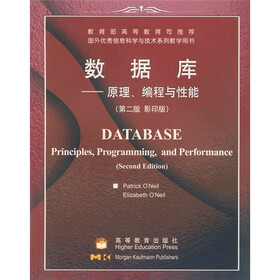
| Parick ONeil is a professor of computer science at the Uniersity of Massachusetts at Boston. He is responsible for a number of important results in transactonal performance and disk access algorithms,and he holds patents for his work in these and other database areas. Elizabeth ONeil is a professor of computer science at the University of Massachusetts at Boston.She serves as a comsult-ant to Sybase IQin Concor, Massachusetts,and has worked with a number of other corporations,includin Microsoft adn Bolt,Beranek,and Newman. |
| Foreword Preface Chapter 1 Introduction 1.1 Fundamental Database Concepts History of Database Systems The Relational and Object-Relational Models The Database Systems Covered A Relational Database Example An Object-Relational Database Example 1.2 Database Users 1.3 Overview of Relational and Object-Relational DBMS Chapter 2: The Relational Model Chapter 3: Basic SQL Query Language Chapter 4: The Object-Relational Model Chapter 5: Programs to Access a Database Chapter 6: Database Design Chapter 7: Integrity, Views, Security, and Catalogs Chapter 8: Indexing Chapter 9: Query Processing Chapter 10: Update Transactions Chapter 11: Parallel and Distributed Databases 1.4 Putting It All Together Chapter 2 The Relational Model 2.1 The CAP Database 2.2 Naming the Parts of a Database Domains and Datatypes Tables and Relations 2.3 Relational Rules 2.4 Keys, Superkeys, and Null Values Null Values 2.5 Relational algebra Fundamental Operations of Relational Algebra 2.6 Set-Theoretic Operations The Union, Intersection, and Difference Operations Assignment and Alias The Product Operation 2.7 Native Relational Operations The Projection Operation The Selection Operation Precedence of Relational Operations The Join Operation The Division Operation 2.8 The Interdependence of Operations 2.9 Illustrative Examples 2.10 Other Relational Operations Outer Join Theta Join Chapter 3 Basic SQL Query Language 3.1 Introduction SQL Capabilities SQL History-Standards and Dialects 3.2 Setting Up the Database Standard Typographical Conventions A Practical Exercise 3.3 Simple Select Statements 3.4 Subqueries The IN Predicate The Quantified Comparison Predicate The EXISTS Predicate A Weakness of SQL: Too Many Equivalent Forms 3.5 UNION Operators and FOR ALL Conditions The UNION Operator Division: SQL "FOR ALL..." Conditions 3.6 Some Advanced SQL Syntax The INTERSECT and EXCEPT Operators in Advanced SQL Join Forms in Advanced SQL OUTER JOIN Join Forms Implemented in Database Systems 3.7 Set Functions in SQL Handling Null Values 3.8 Groups of Rows in SQL 3.9 A Complete Description of SQL Select Identifiers Expressions, Predicates, and the search_condition Scalar Subqueries as Expressions:Advanced SQL Basic SQL versus Advanced SQL: Summary A Discussion of the Predicates 3.10 Insert, Update, and Delete Statements The Insert Statement The Update Statement The Delete Statement 3.11 The Power of the Select Statement The Non-Procedural Select Statement Turing Power Limited Power of the Basic SQL Select Statement Chapter 4 Object-Relational SQL 4.1 Introduction ORSQL Capabilities Form of Presentation for This Chapter Object-Relational History 4.2 Objects and Tables 4.2.1 Object Types in ORACLE Definition of the REF Object Reference 4.2.2 INFORMIX Row Types for Objects Absence of Refs in INFORMIX Type Inheritance in INFORMIX 4.2.3 Objects and Tables: Summary Object Orientation 4.3 Collection Types 4.3.1 Collection Types in ORACLE Table Types and Nested Tables Two Techniques for Retrieving from a Table of Tables Unnesting via Table Products Nested Cursors Array Types for VARRAYs SQL Syntax for Collections in ORACLE Inserts and Updates in ORACLE 4.3.2 Collection Types in INFORMIX Sets in INFORMIX Lists in INFORMIX SQL Syntax for Collections in INFORMIX inserts and Updates in INFORMIX 4.3.3 Collection Types:Summary 4.4 Procedural SQL, User-Defined Functions (UDFs), and Methods 4.4.1 ORACLE PL/SQL Procedures, UDFs, and Methods PL/SQL: ORACLEs Procedural SQL Language Using PL/LQL to Implement Methods in ORACLE Update Methods 4.4.2 INFORMIX User-Defined Functions SPL:INFORMIXs Procedural SQL Language Using SPL to Implement UDFs in INFORMIX Update Functions 4.4.3 User-Defined Functions:Summary 4.5 External Functions and Packaged User-Defined Types(UDTs) Binary Data and BLOBs External Functions Encapsulation Distinct Types BLOB Objects Packaged UDTs and Other Encapsulated UDTs Summary Chapter 5 Programs to Access a Database 5.1 Introduction to Access a Database A Simple Program Using Embedded SQL Selecting Multiple Rows with a Cursor 5.2 Condition Handling Whenever Statement:Scope and Flow of Control Explicit Error Checking Handling Error:Getting Error Messages from the Database Indicator Variables 5.3 Some Common Embedded SQL Statements The Select Statement The Declare Vursor Statement Chapter 6 Database Design Chapter 7 Integrity, Views, Security, and Catalogs Chapter 8 Indexing Chapter 9 Query Processing Chapter 10 Update Transactions Chapter 11 Parallel and Distributed Databases Appendix A Introductory Tutorial Appendix B Programming Details Appendix C SQL Statement Syntax Appendix D Set Query Counts Solutions to Selected Exercises Index |


 内容加载中,请稍后...



商品评论(0条)