网上购物 货比三家
您现在的位置:快乐比价网 > 图书 > 教育/科技 > 数学 > 商品详情

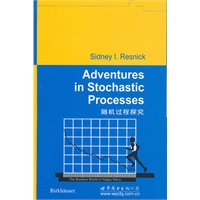
随机过程探究

分享到:
随机过程探究

最 低 价:¥47.60

定 价:¥69.00

作 者:(美)雷斯尼克 著

出 版 社:世界图书出版公司

出版时间:2011-1-1

I S B N:9787510029721

  • 随机过程探究
  • 送货上门
  • 价格
    47.60元
  • 随机过程探究
  • 送货上门
  • 价格
    47.60元
  • 随机过程探究
  • 送货上门
  • 价格
    55.20元
    价格
    55.20元
  • 随机过程探究
  • 送货上门
  • 价格
    60.60元

    商品详情

    编辑推荐

    内容简介

      while this is a book about harry and his adventurous life, it is primarily a serious text about stochastic processes. it features the basic stochas-tic processes that are necessary ingredients for building models of a wide variety of phenomena exhibiting time varying randomness.
      the book is intended as a first year graduate text for courses usually called stochastic processes (perhaps amended by the words "applied" or "introduction to ... ") or applied probability, or sometimes stochastic modelling. it is meant to be very accessible to beginners, and at the same time, to serve those who come to the course with strong backgrounds. this flexiblity also permits the instructor to push the sophistication level up or down. for the novice, discussions and motivation are given carefully and in great detail. in some sections beginners are advised to skip certain devel-opments, while in others, they can read the words and skip the symbols in order to get the content without more technical detail than they are ready to assimilate. in fact, with the numerous readings and variety of prob-lems, it is easy to carve a path so that the book challenges more advanced students, but remains instructive and manageable for beginners. some sections are starred and come with a warning that they contain material which is more mathematically demanding. several discussions have been modularized to facilitate flexible adaptation to the needs of students with differing backgrounds. the text makes crystal clear distinctions between the following: proofs, partial proofs, motivations, plausibility arguments and good old fashioned hand-waving.

    作者简介

    目录

    preface
    chapter 1. preliminaries: discrete index sets and/or discrete state spaces
     1.1. non-negative integer valued random variables
     1.2. convolution
     1.3. generating functions
      1.3.1. differentiation of generating functions
      1.3.2. generating functions and moments
      1.3.3. generating functions and convolution
      1.3.4. generating functions, compounding and random sums
     1.4. the simple branching process
     1.5. limit distributions and the continuity theorem
      1.5.1. the law of rare events
     1.6. the simple random walk
     1.7. the distribution of a process*
     1.8. stopping times*
      1.8.1. wald's identity
      1.8.2. splitting an lid sequence at a stopping time
     exercises for chapter 1
    chapter 2. markov chains
     2.1. construction and first properties
     2.2. examples
     2.3. higher order transition probabilities
     2.4. decomposition of the state space
     2.5. the dissection principle
     2.6. transience and recurrence
     2.7. periodicity
     2.8. solidarity properties
     2.9. examples
     2.10. canonical decomposition
     2.11. absorption probabilities
     2.12. invariant measures and stationary distributions
      2.12.1. time averages
     2.13. limit distributions
      2.13.1 more on null recurrence and transience*
     2.14. computation of the stationary distribution
     2.15. classification techniques
     exercises for chapter 2
    chapter 3. renewal theory
     3.1. basics
     3.2. analytic interlude
      3.2.1. integration
      3.2.2. convolution
      3.2.3. laplace transforms
     3.3. counting renewals
     3.4. renewal reward processes
     3.5. the renewal equation
      3.5.1. risk processes*
     3.6. the poisson process as a renewal process
     3.7. informal discussion of renewal limit theorems;regenerative processes
      3.7.1 an informal discussion of regenerative processes
     3.8. discrete renewal theory
     3.9. stationary renewal processes*
     3.10. blackwell and key renewal theorems*
      3.10.1. direct riemann integrability*
      3.10.2. equivalent forms of the renewal theorems*
      3.10.3. proof of the renewal theorem*
     3.11. improper renewal equations
     3.12. more regenerative processes*
      3.12.1. definitions and examples*
      3.12.2. the renewal equation and smith's theorem*
      3.12.3. queueing examples
     exercises for chapter 3
    chapter 4.point processes
     4.1. basics
     4.2. the poisson process
     4.3. transforming poisson processes
      4.3.1. max-stable and stable random variables*
     4.4. more transformation theory; marking and thinning
     4.5. the order statistic property
     4.6. variants of the poiason process
     4.7. wec. hnlcal basics*
      4.7.1. the laplace functional*
     4.8. more on the poisson process*
     4.9. a general construction of the poisson process;a simple derivation of the order statistic property*
     4.10. more transformation theory; location dependent thinning*
     4.11. records*
     exercises for chapter 4
    chapter 5.continuous time markov chains
     5.1. definitions and construction
     5.2. stability and explosions
      5.2.1. the markov property*
     5.3. dissection
      5.3.1. more detail on dissection*
     5.4. the backward equation and the generator matrix
     5.5. stationary and limiting distributions
      5.5.1. more on invariant measures*
     5.6. laplace transform methods
     5.7. calculations and examples
      5.7.1. queueing networks
     5.8. time dependent solutions*
     5.9. reversibility
     5.10. uniformizability
     5.11. the linear birth process as a point process
     exercises for chapter 5
    chapter 6. brownian motion
     6.1. introduction
     6.2. preliminaries
     6.3. construction of brownian motion*
     6.4. simple properties of standard brownian motion
     6.5. the reflection principle and the distribution of the maximum
     6.6. the strong independent increment property and reflection*
     6.7. escape from a strip
     6.8. brownian motion with drift
     6.9. heavy traffic approximations in queueing theory
     6.10. the brownian bridge and the kolmogorov-smirnov statistic
     6.11. path properties*
     6.12. quadratic variation
     6.13. khintchine's law of the iterated logarithm for brownian motion*
     exercises for chapter 6
    chapter 7. the general random walk*
     7.1. stopping times
     7.2. global properties
     7.3. prelude to wiener-hopf: probabilistic interpretations of transforms
     7.4. dual pairs of stopping times
     7.5. wiener-hopf decompositions
     7.6. consequences of the wiener-hopf factorization
     7.7. the maximum of a random walk
     7.8. random walks and the g/g/1 queue
      7.8.1. exponential right tail
      7.8.2. application to g/m/1 queueing model,
      7.8.3. exponential left tail
      7.8.4. the m/g/1 queue
      7.8.5. queue lengths
    references
    index

    商品评论(0条)

    暂无评论!

    您的浏览历史

    loading 内容加载中,请稍后...