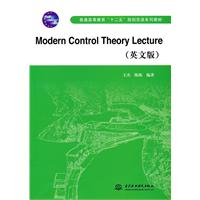
| 《现代控制理论与分析(英文版)》是高等学校电气工程自动化、自动控制、自动化仪表、工业自动化等专业的教材。它是作者经过多年的教学实践并了解学生学习情况,在参阅国内外优秀教材及作者讲授该课讲义的基础上编写的。 本书主要介绍了控制理论的概念、方法和应用;研究状态空间表达式解的存在性和唯一性及相关性质,着重介绍了与解状态空间方程相关的常微分方程基本理论;本书仍保留传统的现代控制理论的章节安排,在关于能控能本书由王杰、陈陈编著。 |
| Introduction 0.1 Development of control theory 0.2 Structural requirements and control features of the system 0.3 Nonlinear control in power system 0.4 The main content of modern control ll~eory Chapter 1 State-space expression of control system 1.1 The basic concepts 1.2 The simulation structure diagram of state:space expression 1.3 The construction of state-space expression 1.4 The construction of state-space expression from transfer function 1.5 Transfer function and transfer function matrix from transfer function to state e 1.6 State-space expression of composite system 1.7 Linear transformation 1.8 State-space expression of discrete system Exercise Chapter 2 The solution of state-space expression of control system 2.1 Solution of homogeneous state equation of linear time-invariant system 2.2 Matrix exponent 2.3 Homogeneous solution of time-varying system 2.4 State transfer matrix 2.5 Solution of linear continuous system non-homogeneous state equation 2.6 Solution of discrete-time system state equation 2.7 Discretization of continuous time-state-space expression Exercise Chapter 3 Controllability and observability of linear system 3.1 Controllability of time-invariant discrete system 3.2 Controllability of time-invariable continuous system 3.3 Observability of time-invariant system 3.4 Controllability and observability of linear time-varying system 3.5 The dual relation of controllability and observability 3.6 Structural decomposition of linear time-invariant system 3.7 Relation of controllability, observability and transfer function matrix 3.8 Controllability standard and observability standard 3.9 System realization Exercise Chapter 4 Stability and Lyapnnov method 4.1 The basic concept of stability 4.2 The basic idea of Lyapunov function 4.3 Lyapunov function stability method 4.4 Asymptotic stability 4.5 Some common construction method of Lyapunov function 4.6 Vector Lyapunov function 4.7 Application of Lyapunov methods in linear system 4.8 Lyapunov method in Hamilton system Exercise Chapter 5 Synthesis of linear time-invariant system 5.1 Definition and property of state feedback 5.2 Pole assignment 5.3 System stabilization problem 5.4 System decoupling problem 5.5 State observer Exercise Chapter 6 Optimal control 6.1 Summary 6.2 Variational methods of solving optimal control 6.3 Hamilton function 6.4 Phorcha problem 6.5 Minimum principle 6.6 Dynamic programming 6.7 Linear quadratic optimal control problem Exercise |



 内容加载中,请稍后...




商品评论(0条)