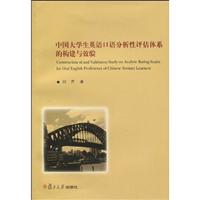
| List of Acronyms List of Figures List ofTables Chapter1 Introduction 1.1 Need for the study 1.1.1 Students perspective 1.1.2 Teachers perspective 1.1.3 Purpose of the study 1.2 Configuration of the study 1.2.1 Study procedure 1.2.2 Study questions 1.3 Significance of the study 1.4 Layout of the book 1.5 Summary Chapter2 Literature Review 2.1 Fundamentals of oral proficiency 2.1.1 Speech communication and its characteristics 2.1.2 Essence of speech communication 2.1.2.1 Language use versus usage 2.1.2.2 Communicative competence versus linguistic competence 2.1.2.3 Accuracy versus fluency 2.1.2.4 Correctness versus appropriateness 2.1.2.5 Proficiency versus achievement 2.1.2.6 Process versus product 2.1.2.7 Synthetic approach versus analytic approach 2.1.2.8 The learner versus the teacher 2.1.3 Components of oral proficiency 2.2 Classification of oral rating scales 2.2.1 Holistic rating scales 2.2.2 Analytic rating scales 2.2.3 Combination of holistic&analytic rating scales 2.2.4 Integration of holistic&analytic rating scales 2.2.5 Using analytic rating scales for the project 2.3 Summary Chapter3 Study Bases 3.1 Empirical basis 3.1.1 Syllabus description 3.1.2 Oral tests of CET&TEM3.2 Theoretical basis 3.2.1 CLA model 3.2.1.1 Language competence 3.2.1.2 Strategic competence3.2.1.3 Psychophysiological mechanisms 3.2.1.4 Significance of CLA to OARS 3.2.1.5 Trait factors of CLA 3.2.2 Cohen's rating scale for pragmatic speaking 3.2.3 Nunn's rating scales for small group interaction 3.2.3.1 Nunn's rating scales of interactive skills3.2.3.2 Nunn's rating scales of intelligibility 3.2.3.3 Significance of Nunn's rating scales to OARS 3.2.4 Reconsiderations on strategic competence 3.2.4.1 Classification of strategic competence 3.2.4.2 Evaluation of nonverbal communication 3.3 Summary Chapter4 Construction of OARS 4.1 Needs analysis 4.1.1 Basic considerations on band descriptors4.1.2 Questionnaire construction 4.1.2.1 The trial questionnaire 4.1.2.2 Demographic analysis 4.1.2.3 Data analysis 4.1.3 Survey results 4.1.3.1 Demographic analysis 4.1.3.2 The OARS questionnaire 4.1.3.3 Data analysis 4.2 Description of OARS 4.2.1 Framework of OARS 4.2.2 Band descriptors of OARS 4.2.2.1 Band descriptors of organizational competence 4.2.2.2 Band descriptors of pragmatic competence 4.2.2.3 Band descriptors of flexible interaction 4.2.2.4 Band descriptors of nonverbal communication 4.3 Sample rating 4.3.1 Sample ratingⅠ-role-play 4.3.1.1 Performance analysis 4.3.1.2 Suggested rating 4.3.2 Sample ratingⅡ—discussion 4.3.2.1 Performance analysis 4.3.2.2 Suggested rating 4.4 Summary Chapter5 The PilotValidation Study 5.1 Research purpose 5.2 Research subjects and task 5.3 Research operation 5.4 Data analysis 5.4.1 Prior consideration 5.4.1.1 Candidates perspective 5.4.1.2 Teachers perspective 5.4.2 The profound study 5.4.2.1 Analysis of reliability estimates 5.4.2.2 Analysis of descriptive statistics5.4.2.3 Analysis of construct validity 5.4.2.4 Analysis of external validity 5.5 Discussion 5.6 Summary Chapter6 The Field Validation Study 6.1 Research purpose 6.2 Research subjects and task 6.3 Research operation 6.3.1 Process of experimental tests 6.3.2 Rater training 6.3.3 Collection of data 6.4 Data analysis 6.4.1 Study on six types of candidates 6.4.1.1 Analysis of reliability estimates 6.4.1.2 Analysis of descriptive statistics6.4.1.3 Analysis of construct validity 6.4.1.4 Analysis of external validity 6.4.2 Study on 180 candidates 6.4.2.1 Analyses of reliability estimates 6.4.2.2 Analyses of descriptive statistics6.4.2.3 Analyses of construct validity 6.4.2.4 Analyses of external validity 6.4.3 Characteristics of oral English proficiency of Chinese college students 6.4.4 Comparability study on different types of candidates 6.5 Discussion 6.6 Summary Chapter7 Conclusions and Recommendations 7.1 Validation results 7.2 Washback effects 7.2.1 Design of OARS as a model 7.2.2 Precautions in application of OARS 7.2.3 Contribution of OARS to oral instruction 7.3 Existing problems 7.3.1 Problems with OARS itself 7.3.2 Problems with the validation study 7.4 Further research 7.5 Summary Bibliography Appendix1 Empirical Basis Appendix1.1 Requirements for Oral Proficiency of English Majors(Chinese version) Appendix1.2 Requirements for Oral Proficiency of non-English Majors(Chinese version) Appendix1.3 Requirements for Pronunciation of English Majors at Band2&Band4(Chinese version) Appendix1.4 Rating Scale&Range Descriptions of CET-SET(Chinese version) Appendix1.5 Range Descriptions of TEM4-Oral(Chinese version) Appendix1.6 Range Descriptions of TEM8-Oral(Chinese version) Appendix2 Questionnaires Appendix2.1 OARS TrialQuestionnaire Appendix2.2 OARS Teachers Questionnaire Appendix2.3 OARS Students QuestionnaireAppendix2.4 Candidate's Questionnaire—the Pilot Study Appendix3 Experiments Appendix3.1 Experimental Test of Sample RatingⅠ Appendix3.2 Experimental Test of Sample RatingⅡ Appendix3.3 Experimental Test of the Validation Study—Role Cards Appendix4 Data of the Validation Study Appendix4.1 Candidates Raw Scores on ORAL,TEM4&TEM8—the Pilot Study Appendix4.2 Raw Scores of Candidates Ratings—the Pilot Study Appendix4.3 Raw Scores of Raters Detailed Ratings—the Pilot Study Appendix4.4 Raw Scores of Teachers Rough Ratings—the Pilot Study Appendix4.5 Sub-total Correlation Matrix —the Pilot Study Appendix4.6 Sub-total Correlation Matrix for English(key)Candidates—the Field Study Appendix4.7 Sub-total Correlation Matrix for Arts(key) Candidates—the Field Study Appendix4.8 Sub-total Correlation Matrix for Science(key)Candidates—the Field Study Appendix4.9 Sub-total Correlation Matrix for Arts(local)Candidates—the Field Study Appendix4.10 Sub-totalCorrelation Matrix for Science(local)Candidates—the Field Study Appendix4.11 Sub-total CorrelationM atrix of R1T for 180Candidates—the Field Study Appendix4.12 Sub-total Correlation Matrix of RAT for 180 Candidates—the Field Study |



 内容加载中,请稍后...




商品评论(0条)