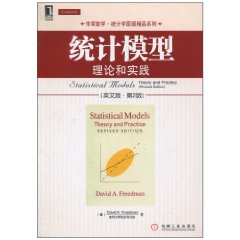
| Table of ContentsForeword to the Revised Edition iiiPreface v1 Observational Studies and Experiments1.1 Introduction 11.2 The HIP trial 41.3 Snow on cholera 61.4 Yule on the causes of poverty 9Exercise set A 131.5 End notes 142 The Regression Line2.1 Introduction 182.2 The regression line 182.3 Hooke's law 22Exercise set A 232.4 Complexities 232.5 Simple vs multiple regression 26Exercise set B 262.6 End notes 283 Matrix Algebra3.1 Introduction 29Exercise set A 303.2 Determinants and inverses 31Exercise set B 333.3 Random vectors 35Exercise set C 353.4 Positive definite matrices 36Exercise set D 373.5 The normal distribution 38Exercise set E 393.6 If you want a book on matrix algebra 404 Multiple Regression4.1 Introduction 41Exercise set A 444.2 Standard errors 45Things we don't need 49Exercise set B 494.3 Explained variance in multiple regression 51Association or causation? 53Exercise set C 534.4 What happens to OLS if the assumptions break down? 534.5 Discussion questions 534.6 End notes 595 Multiple Regression: Special Topics5.1 Introduction 615.20LSisBLUE 61Exercise set A 635.3 Generalized least squares 63Exercise set B 655.4 Examples on GLS 65Exercise set C 665.5 What happens to GLS if the assumptions break down? 685.6 Normal theory 68Statistical significance 70Exercise set D 715.7 The F-test 72"The" F-test in applied work 73Exercise set E 745.8 Data snooping 74Exercise set F 765.9 Discussion questions 765.10 End notes 786 Path Models6.1 Stratification 81Exercise set A 866.2 Hooke's law revisited 87Exercise set B 886.3 Political repression during the McCarthy era 88Exercise set C 90TABLE OF CONTENTS6.4 Inferring causation by regression 91Exercise set D 936.5 Response schedules for path diagrams 94Selection vs intervention 101Structural equations and stable parameters 101Ambiguity in notation 102Exercise set E 1026.6 Dummy variables 103Types of variables 1046.7 Discussion questions 1056.8 End notes 1127 Maximum Likelihood7.1 Introduction 115Exercise set A 1197.2 Probit models 121Why not regression? 123The latent-variable formulation 123Exercise set B 124Identification vs estimation 125What if the Ui are N(/z, tr2)? 126Exercise set C 1277.3 Logit models 128Exercise set D 1287.4 The effect of Catholic schools 130Latent variables 132Response schedules 133The second equation 134Mechanics: bivariate probit 136Why a model rather than a cross-tab? 138Interactions 138More on table 3 in Evans and Schwab 139More on the second equation 139Exercise set E 1407.5 Discussion questions 1417.6 End notes 1508 The Bootstrap8.1 Introduction 155Exercise set A 1668.2 Bootstrapping a model for energy demand 167Exercise set B 1738.3 End notes 1749 Simultaneous Equations9.1 Introduction 176Exercise set A 1819.2 Instrumental variables 181Exercise set B 1849.3 Estimating the butter model 184Exercise set C 1859.4 What are the two stages? 186Invariance assumptions 1879.5 A social-science example: education and fertility 187More on Rindfuss et al 1919.6 Covariates 1929.7 Linear probability models 193The assumptions 194The questions 195Exercise set D 1969.8 More on IVLS 197Some technical issues 197Exercise set E 198Simulations to illustrate IVLS 1999.9 Discussion questions 2009.10 End notes 20710 Issues in Statistical Modeling10.1 Introduction 209The bootstrap 211The role of asymptotics 211Philosophers' stones 211The modelers' response 21210.2 Critical literature 21210.3 Response schedules 21710.4 Evaluating the models in chapters 7-9 21710.5 Summing up 218References 219Answers to Exercises 235TABLE OF CONTENTSThe Computer Labs 294Appendix: Sample MATLAB Code 310ReprintsGibson on McCarthy 315Evans and Schwab on Catholic Schools 343Rindfuss et al on Education and Fertility 377Schneider et al on Social Capital 402Index 431 |





 内容加载中,请稍后...





商品评论(0条)