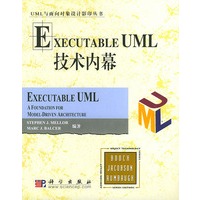
最 低 价:¥34.20
定 价:¥45.00
作 者:(美) 梅勒(Mellor,S.J.),(美)巴尔塞(Balcer,M.J.) 著 著
出 版 社:科学出版社
出版时间:2003-5-1
I S B N:9787030114013

| |
|
|
| Foreword Preface Acknowledgments Chapter 1 Introduction 1.1 Raising the Level of Abstraction 1.2 Executable UML 1.3 Making UML Executable 1.4 Model Compilers 1.5 Model-Driven Architecture 1.6 References Chapter 2 Using Executable UML 2.1 The System Model 2.2 Modeling a single Domain 2.3 Verification and Execution 2.4 The Big Picture 2.5 References Chapter 3 Domains and Bridges 3.1 Domains 3.2 Domains and Requirements 3.3 Bridges 3.4 Aspects and Join Points 3.5 Domains and Aspects 3.6 References Chapter 4 Use Cases 4.1 Basics of Use Cases 4.2 Working with Use Cases 4.3 Activity Diagrams 4.4 Formalizing Use Cases 4.5 Scenarios and Testing 4.6 System Modeling 4.7 References Chapter 5 Classes and Attributes 5.1 Classes 5.2 Attributes 5.3 Attributes Data Types 5.4 Documenting Classes and Attributes 5.5 Checking Classes and Attributes 5.6 Rules,Rules,Rules 5.7 References Chapter 6 Relationships and Associations 6.1 Associations 6.2 Associations Descriptions 6.3 Checking Associations 6.4 Associations Classes 6.5 Generalization and Specialization 6.6 Reflexive Associations 6.7 The Class Model 6.8 References Chapter 7 Class Actions 7.1 Object and Attribute Actions 7.2 Selection Expressions 7.3 Link Actions 7.4 Link Object Actions 7.5 Generalization Hierarchies 7.6 Other Action Languages 7.7 References Chapter 8 Constraints 8.1 Unique Instance Constraints 8.2 Derived Attributes 8.3 Referential Constraints 8.4 Association Loops 8.5 Constraints Capture Semantics 8.6 References Chapter 9 Lifecycles 9.1 Concept of a Lifecycle 9.2 State Machine 9.3 State Transition Table 9.4 Creating and Deleting Objects 9.5 Forming Lifecycles 9.6 Lifecycles for Classes 9.7 References Chapter 10 Communicating Objects 10.1 Signals 10.2 Creating and Deleting Objects 10.3 Visualizing Domain Dynamics 10.4 Domain Dynamics Chapter 11 Synchronizing Objects 11.1 How to Think about Time 11.2 Rules about Signals 11.3 Rules about procedures 11.4 Rules about Data Access 11.5 Delayed Signals and Time Events 11.6 Rules,Rules,Rules 11.7 References Chapter 12 Using Lifecycles 12.1 Statechart Diagram Construction Techniques 12.2 Reworking the Class Diagram 12.3 References Chapter 13 Relationship Dynamics 13.1 Dynamically Simple Associations 13.2 Associstions Involving Competition 13.3 Dynamics in Generalization Hierarchies 13.4 Polymorphic Events and Polymorphic Signals 13.5 Reclassification 13.6 References Chapter 14 Domain Dynamics 14.1 Partitioning Control 14.2 Control Strategies 14.3 Delegation of Control 14.4 Input Conditioning 14.5 Distrbuted Dynamics 14.6 References Chapter 15 Domain Verification 15.1 Finding Unit Tests for a Single Use Case 15.2 Test Execution 15.3 System Tests 15.4 Finding Test Cases from the Models 15.5 The Verifiction Gap 15.6 References Chapter 16 Model Management 16.1 Dividing Large Domains 16.2 Subsystems and the Class Diagram 16.3 Collaboations between Subsystems 16.4 Adjusting Subsystem partitioning 16.5 Model Management Chapter 17 Joining Multple Domains 17.1 Kinds of Domains 17.2 Anonymous Explicit Bridges 17.3 Implicit Bridging weth Join Points 17.4 Bridging to the Model Compiler Chapter 18 Model Compilers 18.1 Compiling the Models:The Bookstore 18.2 Model Compilers and the Software Platform 18.3 Fit 18.4 Buying,Modifying,and Building a Model Compiler 18.5 Modeling the Model Compiler as a Domain 18.6 References Appendix A Glossary Appendix B Case Sthdy B.1 Subsystem producSpecification B.2 Subsystem Ordering B.3 Subsystem Shipping B.4 Domain Data Types B.5 Object Collaboration Diagram Index |



 内容加载中,请稍后...


商品评论(0条)