最 低 价:¥544.20

| The LNAI series reports state-of-the-art results in artificial intelligence re-search, development, and education, at a high level and in both printed and electronic form. Enjoying tight cooperation with the R&D community, with numerous individuals, as well as with prestigious organizations and societies, LNAI has grown into the most comprehensive artificial intelligence research forum available. The scope of LNAI spans the whole range of artificial intelligence and intelli- gent information processing including interdisciplinary topics in a variety of application fields. The type of material published traditionally includes. proceedings (published in time for the respective conference); post-proceedings (consisting of thoroughly revised final full papers); research monographs (which may be based on PhD work). |
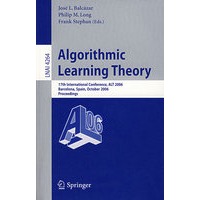
| Editors' Introduction Invited Contributions Solving Semi-infinite Linear Programs Using Boosting-Like Methods e-Science and the Semantic Web: A Symbiotic Relationship Spectral Norm in Learning Theory: Some Selected Topics Data-Driven Discovery Using Probabilistic Hidden Variable Models Reinforcement Learning and Apprenticeship Learning for Robotic Control Regular Contributions Learning Unions of co(l)-Dimensional Rectangles On Exact Learning Halfspaces with Random Consistent Hypothesis Oracle Active Learning in the Non-realizable Case How Many Query Superpositions Are Needed to Learn? Teaching Memoryless Randomized Learners Without Feedback The Complexity of Learning SUBSEQ(A) Mind Change Complexity of Inferring Unbounded Unions of Pattern Languages from Positive Data Learning and Extending Sublanguages Iterative Learning from Positive Data and Negative Counterexamples Towards a Better Understanding of Incremental Learning On Exact Learning from Random Walk Risk-Sensitive Online Learning Leading Strategies in Competitive On-Line Prediction Hannah Consistency in On-Line Learning in Case of Unbounded Losses Under Partial Monitoring General Discounting Versus Average Reward The Missing Consistency Theorem for Bayesian Learning: Stochastic Model Selection Is There an Elegant Universal Theory of Prediction? Learning Linearly Separable Languages Smooth Boosting 0-sing an Inf'ormation-l~asecf Cri'teri'on …… Author Index |


 内容加载中,请稍后...


商品评论(0条)