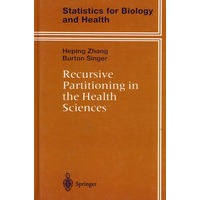
| 作者简介: Heping Zhang is Associate Professor of Biostatistics and Child Study at Yale University. In addition to the methodology and application of recursive partitioning, he is interested in developing statistical methods for analyzing correlated data, especially family and genetic studies, and brain imaging problems. Burton Singer, a member of the National Academy of Sciences, is Professor of Demography and Public Affairs at Princeton University. His research interests include combinatorial formulation of randomness, infectious disease epidemiology, and bio-demography of aging. |
| Preface 1 Introduction 1.1 Examples Using CART 1.2 The Statistical Problem 1.3 Outline of the Methodology 2 A Practical Guide to Tree Construction 2.1 The Elements of Tree Construction 2.2 Splitting a Node 2.3 Terminal Nodes 2.4 Download and Use of Software 3 Logistic Regression 3.1 Logistic Regression Models 3.2 A Logistic Regression Analysis 4 Classification Trees for a Binary Response 4.1 Node Impurity 4.2 Determination of Terminal Nodes 4.2.1 Misclassification Cost 4.2.2 Cost Complexity 4.2.3 Nested Optimal Subtrees 4.3 The Standard Error of Rcu 4.4 Tree-Based Analysis of the Yale Pregnancy Outcome Study 4.5 An Alternative Pruning Approach 4.6 Localized Cross-Validation 4.7 Comparison Between Tree-Based and Logistic Regression Analyses 4.8 Missing Data 4.8.1 Missings Together Approach 4.8.2 Surrogate Splits 4.9 Tree Stability 4.10 Implementation 5 Risk-Factor Analysis Using Tree-Based Stratification 5.1 Background 5.2 The Analysis 6 Analysis of Censored Data: Examples 6.1 Introduction 6.2 Tree-Based Analysis for the Western Collaborative Group Study Data 7 Analysis of Censored Data:Concepts and Classical Methods 7.1 The Basics of Survival Analysis 7.1.1 Kaplan-Meier Curve 7.1.2 Log-Rank Test 7.2 Parametric Regression for Censored Data 7.2.1 Linear Regression with Censored Data 7.2.2 Cox Proportional Hazard Regression 7.2.3 Reanalysis of the Western Collaborative Group Study Data 8 Analysis of Censored Data: Survival Trees 8.1 Splitting Criteria 8.1.1 Gordon and Olshen's Rule 8.1.2 Maximizing the Difference 8.1.3 Use of Likelihood Functions 8.1.4 A Straightforward Extension 8.2 Pruning a Survival Tree 8.3 Implementation 8.4 Survival Trees for the Western Collaborative Group Study Data 9 Regression Trees adn Adaptive Splines for a Continuous Response 10 Analysis of Longitudinal Data 11 Analysis of Multiple Discrete Responses 12 Appendix References Index |



 内容加载中,请稍后...




商品评论(0条)