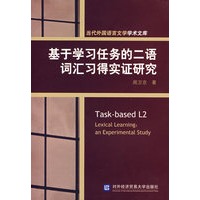
| 周卫京,博士,现为江苏大学外国语学院副教授,英语教育专业学科带头人。
2006-2007年于剑桥大学语言系语音实验室研修英语语音学和二语语言教学。 2000年、2003年先后考取南京大学英语语言文学专业研究生,博士生,师从文秋芳教授研修应用语言学,获硕士,博士学位。 主要研究方向:应用语言学,第二语言习得,赛珍珠研究。 在外语类核心期刊和国际会议发表论文6篇,参与国家重点社科基金项目1项,主持江苏省社科,教育基金项目3项。 |
| Declaration Acknowledgements 导读 List of Abbreviations Table of Contents List of Tables List of Figures Introduction 0.1 Motivation 0.2 Rationale and research orientation of the present study 0.3 Overture to the present study 0.4 Outline of the dissertation PART Ⅰ LITERATURE REVIEW Chapter 1 Task-based L2 Lexical Learning 1.1 Introduction 1.2 Definition of key terms 1.2.1 Lexical unit 1.2.1.1 Word 1.2.1.2 Word family 1.2.1.3 Lexical unit 1.2.2 L2 lexical learning 1.2.2.1 What to learn 1.2.2.2 How to learn 1.2.3 Tasks for L2 lexical learning 1.2.3.1 Definition of ' task' in SLA 1.2.3.2 Main features of tasks in SLA 1.3 Effects of task type on L2 lexical learning 1.3.1 L2 lexical learning via reading tasks 1.3.2 L2 lexical learning via listening tasks 1.3.3 L2 lexical learning via speaking tasks 1.3.4 L2 lexical learning via writing tasks 1.4 Effects of task frequency on 1_2 lexical learning 1.5 Effects of textual, lexical and learner factors on L2 lexical learning 1.6 Summary Chapter 2 Controversies over Incidental and Intentional L2 Lexical Learning 2.1 Introduction 2.2 Traditional dichotomy between incidental and intentional L2 lexical learning 2.3 Arguments for incidental lexical learning and empirical findings 2.3.1 Default argument 2.3.2 Empirical evidence 2.4 Arguments for intentional L2 lexical learning and empirical findings 2.4.1 Pedagogical advocacy 2.4.2 Empirical evidence …… Chapter 3 Controersies over Involvement Load Hypothesis PART Ⅱ METHODOLOGY PART Ⅲ RESULTS AND DISCUSSIONS PART Ⅳ CONCLUSION Appendix References |



 内容加载中,请稍后...







商品评论(0条)