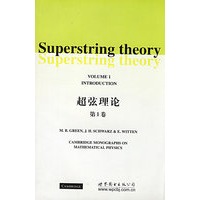
| Preface 1 Introduction 1.1 The early days of dual models 1.1.1 The Veneziano amplitude and duality 1.1.2 High-energy behavior of the Veneziano model 1.1.3 Ramifications of the Veneziano model 1.2 Dual models of everything 1.2.1 Duality and the graviton 1.2.2 Unification in higher dimensions 1.2.3 Supersymmetry 1.3 String theory 1.3.1 The massless point particle 1.3.2 Generalization to strings 1.3.3 Constraint equations 1.4 String interactions 1.4.1 Splitting of strings 1.4.2 Vertex operators 1.4.3 Use of vertex operators 1.4.4 Evaluation of the scattering amplitude 1.4.5 The mass of the graviton 1.5 Other aspects of string theory 1.5.1 Gravitational Ward identities 1.5.2 Open strings 1.5.3 Internal symmetries of open strings 1.5.4 Recovery of the Veneziano amplitude 1.5.5 Comparison with QCD 1.5.6 Upitarity and gravity 1.6 Conclusion 2 Free bosonic strings 2.1 The classical bosonic string 2.1.1 String action and its symmetries 2.1.2 The free string in Minkowski space 2.1.3 Classical covariant gauge fixing and field equations 2.2 Quantization - old covariant approach 2.2.1 Commutation relations and mode expansions 2.2.2 Virasoro algebra and physical states 2.2.3 Vertex operators 2.3 Light-cone gauge quantization 2.3.1 Light-cone gauge and Lorentz algebra 2.3.2 Construction of transverse physical states 2.3.3 The no-ghost theorem and the spectrum-generating algebra 2.3.4 Analysis of the spectrum 2.3.5 Asymptotic formulas for level densities 2.4 Summary 3 Modern covariant quantization 3.1 Covariant path-integral quantization 3.1.1 Fazideev-P0pov ghosts 3.1.2 Complex world-sheet tensor calculus 3.1.3 Quantizatlon of the ghosts 3.2.1 Construction of BRST charge 3.2.2 Covariant calculation of the Virasoro anomaly 3.2.3 Virasoro, conformal and gravitational anomalies 3.2.4 Bosonization of ghost coordinates 3.3 Global aspects of the string world sheet 3.4 Strings in background fields 3.4.1 Introduction of a background spa~e-time metric 3.4.2 Weyl invariance 3.4.3 Conformal invariance and the equations of motion 3.4.4 String-theoretic corrections to general relativity 3.4.5 Inclusion of other modes 3.4.6 The dilaton expectation value and the string coupling constant 3.5 Summary 4 World-sheet supersymmetry in string theory 4.1 The classical theory 4.1.1 Global world-sheet supersymmetry 4.1.2 Superspace 4.1.3 Constraint equations 4.1.4 Boundary conditions and mode expansions 4.2 Quantization - the old covariant approach 4.2.1 Commutation relations and mode expansions 4.2.2 Super-Virasoro algebra and physical states 4.2.3 Boson-emission vertex operators 4.3 Light-cone gauge quantization 4.3.1 The light-cone gauge 4.3.2 No-ghost theorem and the spectrum-generating algebra 4.3.3 The GSO conditions 4.3.4 Locally supersymmetric form of the action 4.3.5 Superstring action and its symmetries 4.4 Modern covariant quantization 4.4.1 Faddeev-Popov ghosts 4.4.2 BRST symmetry 4.4.3 Covariant computation of the Virasoro anomaly 4.5 Extended world-sheet supersymmetry 4.5.1 The N = 2 theory 4.5.2 The N = 4 theory 4.6 Summary 4.A Super Yang-Mills theories 5 Space-time supersymmetry in string theory 6 Nonabelian gauge symmetry 7 Tree amplitudes Bibliography Index |



 内容加载中,请稍后...






商品评论(0条)