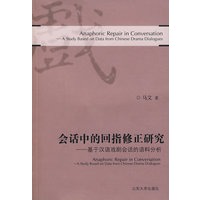
| 马文,男,1972年生,山东梁山人。2004年6月毕业于上海外国语大学,获外国语言学及应用语言学博士学位。2006年10月至2007年9月作为荣誉访问学者赴英国约克大学访问,其问在约克大学交际研究中心从事博士后研究工作,方向为“日常会话中人称指代的会话分析研究”。现为山东大学外国语学院副教授、硕士生导师。研究方向为对比语言学、会话分析及认知语言学。在《外国语》、《外语学刊》、《外语教学》、《解放军外国语学院学报》等核心期刊上发表学术论文近二十篇。目前主持2006国家社科基金项目一项,主持山东大学校级课题一项,另参加国家社科基金项目和山东省社科基金项目各一项。 |
| Chapter One Introduction 1.1 Conversational Repair and Anaphoric Repair 1.1.1 Definition of conversational repair 1.1.2 Toward a definition of anaphoric repair 1.2 A Brief Literature Review 1.3 General Aims and Objectives 1.4 Methodology 1.5 Data Used for Analysis 1.6 Organization of the Present Study Chapter Two Classifications of Anaphoric Repair 2.1 Introduction 2.2 A Functional Classification 2.2.1 Anaphoric repair for referential unclearness 2.2.2 Anaphoric repair for lexieal understanding 2.2.3 Anaphoric repair for identity negotiation 2.2.4 Anaphoric repair for listening problem 2.2.5 Anaphoric repair for speaking error ~ 2.3 Appropriateness-repair Versus Error-repair 2.4 A Formal Classification 2.4.1 Repair of a pronominal form 2.4.2 Repair of a non-pronominal form 2.5 Summary Chapter Three Basic Patterns and Structural Preferences of Anaphorie Repair 3.1 Introduction 3.2 Basic Patterns and Structural Preferences of Conversational Repair 3.3 Four Patterns of Anaphoric Repair 3.3.1 Self-initiated self-repair 3.3.2 Other-initiated self-repair 3.3.3 Other-initiated other-repair 3.3.4 Self-initiated other-repair 3.4 Structural Preferences of Anaphoric Repair in Chinese Conversation 3.4.1 Distribution of the four basic patterns of anaphoric repair 3.4.2 Self-initiation versus other-initiation 3.4.3 Self-repair versus other-repair 3.5 Summary Chapter Four Initiation Types and Techniques in Anaphoric Repair 4.1 Introduction 4.2 Initiation Types 4.2.1 Specific information request 4.2.2 Non-specific request for repetition 4.2.3 Expression of lexical uncertainty 4.2.4 Candidate understanding 4.2.5 Clarification,request 4.2.6 Objection 4.2.7 Preemptive initiation 4.2.8 Minimal dysfluency 4.2.9 Without explicit initiation marker 4.3 Initiation Techniques 4.3.1 Question particle or question word 4.3.2 Repeat of the trouble source 4.3.3 Repeat of the trouble sourceq-question word 4.3.4 Question 4.3.5 Candidate alternative 4.3.6 Negative word or clause 4.3.7 Sound stretch, cut-off or non-lexical filler 4.3.8 Without separable initiator 4.3.9 The scale of initiation techniques 4.3.10 Practices of combining different techniques 4.4 Summary Chapter Five Repair Strategies in Anaphoric Repair Chapter Six Referential Choice and Interpretation of Anaphoric Repair Chapter Seven Conclusion 附录 中国现代戏剧 Bibliography |



 内容加载中,请稍后...






商品评论(0条)