网上购物 货比三家
您现在的位置:快乐比价网 > 图书 > 教育/科技 > 原版书与影印版 > 商品详情

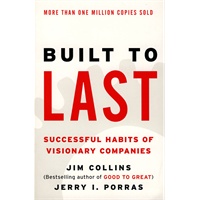
基业常青 Built to Last

分享到:
基业常青 Built to Last

最 低 价:¥65.00

定 价:¥65.00

作 者:Jim Collins,Jerry I. Porras 著

出 版 社:Simon & Schuster

出版时间:2002-8-1

I S B N:9780060516406

  • Plan of Attack
  • 送货上门
  • 价格
    65.00元
  • BUILT TO LAST
  • 送货上门
  • 价格
    93.20元
    价格
    95.40元
    价格
    115.20元

    商品详情

    编辑推荐

    内容简介

    This analysis of what makes great companies great has been hailed everywhere as an instant classic and one of the best business titles since In Search of Excellence。The authors,James C。Collins and Jerry I。 Porras,spent six years in research, and they freely admit that their own preconceptions about business success were devastated by their actual findings--along with the preconceptions of virtually everyone else。
      Built to Last identifies 18 “visionary” companies and sets out to determine what's special about them。 To get on the list,a company had to be world famous,have a stellar brand image,and be at least 50 years old。 We're talking about companies that even a layperson knows to be,well,different:the Disneys,the Wal-Marts,the Mercks。
      Whatever the key to the success of these companies,the key to the success of this book is that the authors don't waste time comparing them to business failures。Instead,they use a control group of “successful-but-second-rank“ companies to highlight what's special about their 18 “visionary“ picks。Thus Disney is compared to Columbia Pictures,Ford to GM,Hewlett Packard to Texas Instruments, and so on。
      The core myth,according to the authors, is that visionary companies must start with a great product and be pushed into the future by charismatic leaders。There are examples of that pattern, they admit:Johnson & Johnson,for one。 But there are also just too many counterexamples--in fact,the majority of the “visionary“ companies,including giants like 3M,Sony,and TI,don't fit the model。 They were characterized by total lack of an initial business plan or key idea and by remarkably self-effacing leaders。 Collins and Porras are much more impressed with something else they shared:an almost cult-like devotion to a “core ideology“ or identity, and active indoctrination of employees into “ideologically commitment“ to the company。
      The comparison with the business “B”-team does tend to raise a significant methodological problem:which companies are to be counted as “visionary“ in the first place? There's an air of circularity here,as if you achieve “visionary“ status by,achieving visionary status。So many roads lead to Rome that the book is less practical than it might appear。But that's exactly the point of an eloquent chapter on 3M。 This wildly successful company had no master plan, little structure,and no prima donnas。Instead it had an atmosphere in which bright people were both keen to see the company succeed and unafraid to “try a lot of stuff and keep what works。” --Richard Farr ——This text refers to an out of print or unavailable edition of this title。
      What makes a visionary company? This book, written by a team from Stanford's Graduate School of Business, compares what the authors have identified as “visionary” companies with selected companies in the same industry。The authors juxtapose Disney and Columbia Pictures, Ford and General Motors, Motorola and Zenith,and Hewlett-Packard and Texas Instruments,to name a few。The visionary companies, the authors found out, had a number of common characteristics; for instance, almost all had some type of core ideology that guided the company in times of upheaval and served as a constant bench mark。 Not all the visionary companies were founded by visionary leaders, however。 On the whole, this is an intriguing book that occasionally provides rare and interesting glimpses into the inner workings and philosophical foundations of successful businesses。 Recommended for all libraries。

    作者简介

    目录

    Author’S Note
    Acknowledgements
    Introduction tO the
    Paperback Edition
    Preface
    Chapter l:The Best 0f the Best
    Chapter 2:Clock Building,Not Time Telling
    Interlude:No“Tyranny of the OR”
    Chapter 3:More Than Profits
    Chapter 4:Preserve the Core/Stimulate Progress
    Chapter 5:Big Hairy Audacious Goals
    Chapter 6:Cult—Like Cultures
    Chapter 7:Try a Lot 0f Stuff and Keep WhatWorks
    Chapter 8:Home-Grown Management
    Chapter 9:Good Enough Never Is
    Chapterl0:The End of the Beginning
    Chapterll:Building the Vision
    Epiogue:Frequently Asked Questions
    Appendix 1:Research Issues
    Appendix 2:Founding Roots of
    Visionary Companies and
    Comparison Companies
    Appendix3:Tables
    Appendix4:Chapter Notes
    Index

    商品评论(0条)

    暂无评论!

    您的浏览历史

    loading 内容加载中,请稍后...