最 低 价:¥102.40

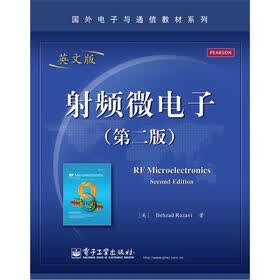
| CONTENTS CHAPTER 1 INTRODUCTION TO RF AND WIRELESS TECHNOLOGY 1.1 A Wireless World 1.2 RF Design Is Challenging 1.3 The Big Picture References CHAPTER 2 BASIC CONCEPTS IN RF DESIGN 2.1 General Considerations 2.1.1 Units in RF Design 2.1.2 Time Variance 2.1.3 Nonlinearity 2.2 Effects of Nonlinearity 2.2.1 Harmonic Distortion 2.2.2 Gain Compression 2.2.3 Cross Modulation 2.2.4 Intermodulation 2.2.5 Cascaded Nonlinear Stages 2.2.6 AM/PM Conversion 2.3 Noise 2.3.1 Noise as a Random Process 2.3.2 Noise Spectrum 2.3.3 Effect of Transfer Function on Noise 2.3.4 Device Noise 2.3.5 Representation of Noise in Circuits 2.4 Sensitivity and Dynamic Range 2.4.1 Sensitivity 2.4.2 Dynamic Range 2.5 Passive Impedance Transformation 2.5.1 Quality Factor 2.5.2 Series-to-Parallel Conversion 2.5.3 Basic Matching Networks 2.5.4 Loss in Matching Networks 2.6 Scattering Parameters 2.7 Analysis of Nonlinear Dynamic Systems 2.7.1 Basic Considerations 2.8 Volterra Series 2.8.1 Method of Nonlinear Currents References Problems CHAPTER 3 COMMUNICATION CONCEPTS 3.1 General Considerations 3.2 Analog Modulation 3.2.1 Amplitude Modulation 3.2.2 Phase and Frequency Modulation 3.3 Digital Modulation 3.3.1 Intersymbol Interference 3.3.2 Signal Constellations 3.3.3 Quadrature Modulation 3.3.4 GMSK and GFSK Modulation 3.3.5 Quadrature Amplitude Modulation 3.3.6 Orthogonal Frequency Division Multiplexing 3.4 Spectral Regrowth 3.5 Mobile RF Communications 3.6 Multiple Access Techniques 3.6.1 Time and Frequency Division Duplexing 3.6.2 Frequency-Division Multiple Access 3.6.3 Time-Division Multiple Access 3.6.4 Code-Division Multiple Access 3.7 Wireless Standards 3.7.1 GSM 3.7.2 IS-95 CDMA 3.7.3 Wideband CDMA 3.7.4 Bluetooth 3.7.5 IEEE802.11a/b/g 3.8 Appendix I: Differential Phase Shift Keying References Problems CHAPTER 4 TRANSCEIVER ARCHITECTURES 4.1 General Considerations 4.2 Receiver Architectures 4.2.1 Basic Heterodyne Receivers 4.2.2 Modern Heterodyne Receivers 4.2.3 Direct-Conversion Receivers 4.2.4 Image-Reject Receivers 4.2.5 Low-IF Receivers 4.3 Transmitter Architectures 4.3.1 General Considerations 4.3.2 Direct-Conversion Transmitters 4.3.3 Modern Direct-Conversion Transmitters 4.3.4 Heterodyne Transmitters 4.3.5 Other TX Architectures 4.4 OOK Transceivers References Problems CHAPTER 5 LOW-NOISE AMPLIFIERS 5.1 General Considerations 5.2 Problem of Input Matching 5.3 LNA Topologies 5.3.1 Common-Source Stage with Inductive Load 5.3.2 Common-Source Stage with Resistive Feedback 5.3.3 Common-Gate Stage 5.3.4 Cascode CS Stage with Inductive Degeneration 5.3.5 Variants of Common-Gate LNA 5.3.6 Noise-Cancelling LNAs 5.3.7 Reactance-Cancelling LNAs 5.4 Gain Switching 5.5 Band Switching 5.6 High-IP2 LNAs 5.6.1 Differential LNAs 5.6.2 Other Methods of IP2 Improvement 5.7 Nonlinearity Calculations 5.7.1 Degenerated CS Stage 5.7.2 Undegenerated CS Stage 5.7.3 Differential and Quasi-Differential Pairs 5.7.4 Degenerated Differential Pair References Problems CHAPTER 6 MIXERS 6.1 General Considerations 6.1.1 Performance Parameters 6.1.2 Mixer Noise Figures 6.1.3 Single-Balanced and Double-Balanced Mixers 6.2 Passive Downconversion Mixers 6.2.1 Gain 6.2.2 LO Self-Mixing 6.2.3 Noise 6.2.4 Input Impedance 6.2.5 Current-Driven Passive Mixers 6.3 Active Downconversion Mixers 6.3.1 Conversion Gain 6.3.2 Noise in Active Mixers 6.3.3 Linearity 6.4 Improved Mixer Topologies 6.4.1 Active Mixers with Current-Source Helpers 6.4.2 Active Mixers with Enhanced Transconductance 6.4.3 Active Mixers with High IP 6.4.4 Active Mixers with Low Flicker Noise 6.5 Upconversion Mixers 6.5.1 Performance Requirements 6.5.2 Upconversion M …… |


 内容加载中,请稍后...



商品评论(0条)