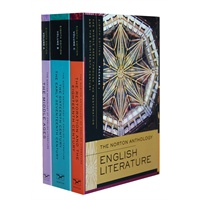
Stephen Greenblatt (Ph.D. Yale) is Cogan University
Professor of English and American Literature and Language at
Harvard University. Also General Editor of The Norton Anthology of
English Literature, Eighth Edition, he is the author of nine books,
including Will in the World: How Shakespeare Became Shakespeare;
Hamlet in Purgatory; Practicing New Historicism; Marvelous
Possessions: The Wonder of the New World, and Learning to Curse:
Essays in Early Modern Culture. He has edited six collections of
criticism, is the co-author (with Charles Mee) of a play, Cardenio,
and is a founding coeditor of the journal Representations. He
honors include the MLA's James Russell Lowell Prize, for
Shakespearean Negotiations: The Circulation of Social Energy in
Renaissance England, the Distinguished Humanist Award from the
Mellon Foundation, the Distinguished Teaching Award from the
University of California, Berkeley. He is a fellow of the American
Academy of Arts and Sciences and the American Philosophical
Society.^M. H. Abrams (Founding Editor Emeritus; Ph.D. Harvard) is
Class of 1916 Professor of English, Emeritus at Cornell University.
He received the Phi Beta Kappa Christian Gauss Prize for The Mirror
and the Lamp and the MLA’s James Russell Lowell Prize for Natural
Supernaturalism. He is also the author of The Milk of Paradise, A
Glossary of Literary Terms, The Correspondent Breeze, and Doing
Things with Texts. He is the recipient of Guggenheim, Ford
Foundation, and Rockefeller Postwar fellowships, the Award in
Humanistic Studies from the Academy of Arts and Sciences (1984),
the Distinguished Scholar Award by the Keats-Shelley Society
(1987), and the Award for Literature by the American Academy of
Arts and Letters (1990). In 1999 The Mirror and the Lamp was ranked
twenty-fifth among the Modern Library’s "100 best nonfiction books
written in English during the twentieth century."^Alfred David
(Ph.D. Harvard) is Professor of English Emeritus at Indiana
University. He is the author of The Strumpet Muse: Art and Morals
in Chaucer’s Poetry, and editor of the "Romaunt of the Rose" in The
Riverside Chaucer and, with George B. Pace, "Chaucer’s Minor Poems
I" in The Variorum Chaucer. He is the recipient of a Sheldon
Travelling Fellowship and Guggenheim and Fulbright Research
fellowships and past president of the New Chaucer Society.
^Barbara K. Lewalski (Ph.D. Chicago) is William R. Kenan Professor
of English and of History and Literature at Harvard University. She
is the recipient of the MLA’s James Russell Lowell Prize for
Protestant Poetics and the Seventeenth-Century Religious Lyric and
the Explicator Prize for Donne’s Anniversaries and the Poetry of
Praise. Her other books include Paradise Lost and the Rhetoric of
Literary Forms, Writing Women in Jacobean England, Milton: A
Critical Biography, and The Polemics and Poems of Rachel Speght
(editor). Lewalski is the recipient of Guggenheim and NEH Senior
fellowships and is a fellow of the American Academy of Arts and
Sciences and Honored Scholar of the Milton Society.^Lawrence
Lipking (Ph.D. Cornell) is Professor of English and Chester D.
Tripp Professor of Humanities at Northwestern University. He
received the Phi Beta Kappa Christian Gauss Prize for The Life of
the Poet. He is also the author of The Ordering of the Arts in
Eighteenth-Century England, Abandoned Women and Poetic Tradition,
and Samuel Johnson: The Life of an Author and editor of High
Romantic Argument. Lipking is the recipient of Guggenheim, ACLS,
Newberry Library, Wilson International Center for Scholars, and NEH
Senior fellowships and is a fellow of the American Academy of Arts
and Sciences.^George M. Logan is James Cappon Professor of English
Language and Literature (Emeritus) at Queen’s University and a
Senior Fellow of Massey College in the University of Toronto. He is
the author of The Meaning of More’s “Utopia” and principal editor
of the current standard Latin-English edition of Utopia (Cambridge
University Press), editor of More’s History of King Richard the
Third and of The Cambridge Companion to Thomas More, and senior
editor of the sixteenth-century section of The Norton Anthology of
English Literature. At Queen’s, he was Head of the Department of
English for nine years and an award-winning teacher.^Katharine
Eisaman Maus (Ph.D. Johns Hopkins) is James Branch Cabell Professor
of English at the University of Virginia. She received the Roland
Bainton Book Prize for Inwardness and Theater in the English
Renaissance. She is also the author of Ben Jonson and the Roman
Frame of Mind; editor of a volume of Renaissance revenge tragedies;
and coeditor of English Renaissance Drama: A Norton Anthology, The
Norton Anthology of English Literature, and a collection of
criticism on seventeenth-century English poetry. She is a recipient
of Guggenheim, NEH, ACLS, and Leverhulme fellowships.^James Noggle
(Ph.D. Berkeley) is Associate Professor of English and Whitehead
Associate Professor of Critical Thought at Wellesley College. He is
the author of The Skeptical Sublime: Aesthetic Ideology in Pope and
the Tory Satirists and is at work on a study of taste and
temporality in eighteenth-century British discourse. He is the
recipient of fellowships from the American Council of Learned
Societies and the American Philosophical Society.^James Simpson
(Ph.D. Cambridge) is Professor of English and American Literature
at Harvard University and former Chair of Medieval and Renaissance
English at the University of Cambridge. An Honorary Fellow of the
Australian Academy of the Humanities, he is the author of Piers
Plowman: An Introduction to the B-Text, Sciences and the Self in
Medieval Poetry, and Reform and Cultural Revolution, 1350–1547,
Volume 2 of The Oxford English Literary History.
|



 内容加载中,请稍后...



商品评论(0条)