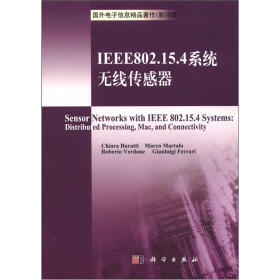
最 低 价:¥44.00

| PartⅠFundamentals 1 Wireless Sensor Networks. 1.1 Wireless Sensor Networks Fundamentals 1.1.1 Main Features of WSNs 1.1.2 Issues Related to Energy Management 1.2 Applications 1.3 IEEE 802.15.4 Technology 1.3.1 IEEE 802.15.4 Physical Layer 1.3.2 IEEE 802.15.4 Network Topologies and Operational Modes 1.3.3 IEEE 802.15.4 MAC Layer 1.3.4 Data Transfer Protocol and MAC Frames 1.3.5 The IEEE 802.15.4 Topology Formation Procedure 1.4 Zigbee Upper Layers 1.4.1 Zigbee Topologies 1.4.2 The Zigbee Tree-Based Topology 1.4.3 The Zigbee Mesh Topology 1.5 Current and Future Research on WSNs 1.5.1 Application-Agnostic Research Trends 1.5.2 Market-and Application-Driven Research Trends 1.6 Further Readings References PartⅡ Distributed Processing 2 Distributed Detection of Spatially Constant Phenomena 2.1 Distributed Detection in Clustered Sensor Networks 2.1.1 Preliminaries on Distributed Binary Detection 2.1.2 Analytical Framework 2.1.3 Communication-Theoretic Characterization 2.1.4 Joint Communication/lnformation-Theoretic Characterization 2.1.5 Realistic Clustered Networks with Data Fusion 2.2 Extending the Lifetime of Clustered Sensor Networks 2.2.1 Sensor Network Lifetime under a Physical Layer Qos Condition 2.2.2 Analytical Computation of Network Lifetime 2.2.3 Numerical Results 2.2.4 Energy Budget 2.2.5 Noisy Communication Links 2.2.6 Throughput and Delay with Varying Sensor Network Lifetime 2.3 Impact of Different SNRs at the Sensors 2.3.1 Ideal Communication Links 2.3.2 Noisy Communication Links 2.3.3 Sensor SNR Profiles 2.3.4 Numerical Results 2.3.5 Experimental Validation 2.4 On the Interplay Between Decoding and Fusion 2.4.1 Distributed Channel Coding and Detection/Decoding/Fusion Strategies 2.4.2 Ideal Observations at the Sensors 2.4.3 Noisy Observations at the Sensors 2.4.4 Impact of Noisy Communication Links Towards the Relay 2.4.5 Numerical Results 2.5 Concluding Remarks 2.6 Further Readings References 3 Distributed Detection of Spatially Non-Constant Phenomena 3.1 Ideal Communication Links 3.1.1 MMSE Fusion Rule 3.1.2 Simplified Fusion Rule with a Single Boundary 3.1.3 Simplified Fusion Rule with Multiple Boundaries 3.2 Noisy Communication Links 3.2.1 MMSE Fusion Rule 3.2.2 Simplified Fusion Rule 3.3 Numerical Results 3.3.1 Ideal Communication Links 3.3.2 Noisy Communication Links 3.4 Computational Complexity 3.5 Concluding Remarks 3.6 Further Readings References PartⅢ MAC and Connectivity PartⅣ Cross-Layer Design Index |





 内容加载中,请稍后...




商品评论(0条)