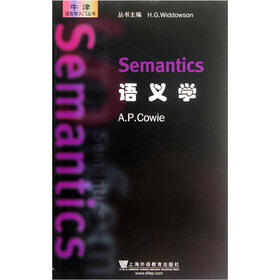
| 人们在对语言的特定细节进行剖析之前,应该对语言整体有个大致的了解。作为语言学研究方向的学生进行深入研究之前的热身阅读,《牛津语言学入门丛书》的主旨是为人们理解那些学术性强的语言学专著奠定理论基础。因为这套丛书浅显易懂,对那些感兴趣却并非专门从事语言研究的人进一步了解语言也大有裨益。 《语义学》是一部介绍语义学基础知识的著作,分6章对语言的定义进行描述和探讨。 |
| Preface Author's preface SECTION I Survey 1 Words and meanings Words, words, words Multiple meaning Meaningful relations Set sentences Components of meaning Summary 2 Word-formation Lexicalization Productivity Prefixes Suffixes Conversion Compounds Winners and losers 3 Multiple meaning Polysemy and homonymy Testing for meanings Specialization of meaning Metaphor Classes of metaphors Metonymy Creativity and slang 4 Meaningful relations Pairs and groupings: synonymy Pairs and groupings: ranks Binary contrasts: antonyms Binary contrasts: complementaries Binary contrasts: converses Groupings: hyponymy Groupings: non-branching hierarchies 5 Set phrases Set phrases and set sentences Collocations Idioms Proverbs, catchwords, and formulae Set phrases and creativity 6 Components of meaning Componential analysis Marked and unmarked Some advantages of a componential approach Denotation and connotation 7 Semantics and the dictionary Grammatical and lexical items Complex words Multiple meaning Meaningful relations Componential analysis Phraseology Conclusions SECTION Z Readings SECTION 3 References SECTION 4 Glossary Acknowledgements |



 内容加载中,请稍后...





商品评论(0条)