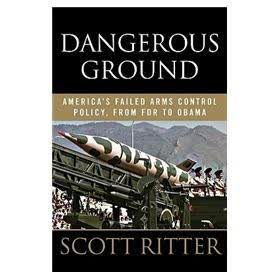
| Which part of the world is going to blow up next? Former UN weapons inspectors travels to the new global trouble spots in search of answer - finding that many potential points of trouble are being exacerbated by US foreign policy. Throughout his career, Scott Ritter has been a controversial and uncompromising figure. He led aggressive UN WMD inspection teams in Iraq in the 1990s. His work on counter-proliferation has led him to clash with national governments and become a target of organized crime groups. Owning to this experience, he is also one of the world's leading experts on arms control and proliferation. In his new book "Dangerous Ground", Ritter offers a sobering analysis of deteriorating world order. Ritter travels to some of the world's most dangerous places, places that don't ordinarily lend themselves to traditional weapons inspections. Visiting Asia, the Middle East, and the former Soviet Union, Ritter's intelligence assessments and forecasting are based on his careful empirical considerations and challenge the rhetoric of many of so-called armchair security professionals and defence intellectuals. Ritter shows that there are real security threats out there, especially in South Asia. But he argues that the dangers of arms proliferation and nuclear terrorism have been stoked by the Bush administration's Disarmament and Non-Proliferation Policy, policies that threaten to poison the international environment for decades. For decades, the trend in U.S. foreign policy circles and government was toward disarmament and nonproliferation. That changed with the Bush administration. The aggressive pursuit of unilateralism, the decision to withdraw from arms treaties and the ratification of the Treaty of Moscow is likely to trigger further catastrophe. Ritter writes: 'So long as the United States continues to behave as if it has sole authority to deviate from international law, there can be no hope for any meaningful progress in the field of threat reduction...Indeed, the opposite will occur-a world grown wary of American treachery will seek to acquire the means to deter, and perhaps even push back, what it sees as an American unilateral domination of the globe'. Ritter provides a blueprint, however, for a what an international arms control regime should look like, looking at the legacy of organizations like the recently mothballed UNMOVIC which created a cadre of international experts in the field of nonproliferation. 'The hundreds of inspectors who have completed this training stood ready to go anywhere in the world at a moment's notice to investigate whether a given manufacturing process was legitimately utilized or instead covertly diverted for illegitimate use', Ritter argues, 'This inspection capability far exceeded anything the world would ever need in Iraq, and had great potential for pre-emptive application in any number of proliferation trouble spots, from Iran to North Korea and beyond'. |


 内容加载中,请稍后...



商品评论(0条)