最 低 价:¥88.30

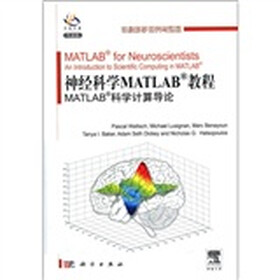
| 《神经科学Matlab教程:Matlab科学计算导论(导读版)》特点: 第一本全面的聚焦于神经科学和心理学的MATLAB教材。 计算方法和案例解释均利用真正的实验数据,提供真实数据的外观和感觉。 指导网站配有图片库、可执行的代码、实例和解决方案。 |
| Pascal Wallisch, PhD, Center for Neural Science, New York University Pascal received his PhD from the Uruversity of Chicago and is now a postdoctoral fellow at New York University. He is currently studying the processing of visual motion. Pascal is passionate about teaching, as well as the communication of scientific concepts to a wider audience. He was recognized for his distinguished teaching record by the University of Chicago Booth Prize. Michael Lusignan, Committee on Computational Neuroscience, University of Chicago Michael is an advanced graduate student who has enjoyed teaching several courses involving MATLAB to graduate, as well as undergraduate students. He infuses his teaching with eight years of experience in active software development. His current interests include sensory encoding in neuroethological model systems. Marc Benayoun, Committee on Computational Neuroscience, University of Chicago Marc is an MD/PhD student currently interested in applying statistical field theory to study neural networks with applications to epilepsy. He has an extensive teaching record and was also awarded theUniversity of Chicago Booth Prize. Tanya L Baker, PhD, Junior Research Fellow, Crick-Jacobs Center for Theoretical Neurobiology, The Salk Institute for Biological Studies, La Jolla, California Tanya is a junior research fellow modeling large-scale neuronal population dynamics using modern statistical methods. Previously, she was a post-doctoral lecturer at the University of Chicago where she developed and taught Mathematical Methods for the Biological Sciences, a new year-long course with a computer lab component.She received her PhD in Physics at the University of Chicago and her BS in Physics and Applied Mathematics at UCLA. Adam Dickey, Committee on Computational Neuroscience, University of Chicago Adam is an MD/PhD candidate at the University of Chicago. He is currently a graduate sfudent in the laboratory of Dr. Nicholas Hatsopoulos. Adam is interested in improving decoding techniques used for neuralprosthetic control. Nicholas G. Hatsopoulos, PhD, Department of Organismal Biology and Anatomy & Department of Neurology, University of Chicago Nicholas is Associate Professor and Chairman of the graduate program on Computational Neuroscience. He teaches a course inCognitive Neuroscience which formed the basis for some of the chapters in the books.His research focuses on how ensembles of cortical neurons work together to control,coordinate,and learn complex movements of the arm and hand.He is also developing brain-machine interfaces by which patients with severe motor disabitities could activate large groups of neurons to control external devices. |
| 前言 作者简介 如何使用本书 第一部分 基本原理 1 入门 2 MATLAB指南 第二部分 MATLAB数据收集 3 视觉搜索和突显 4 注意 5 心理物理学 6 信号检测论 第三部分 MATLAB数据分析 7 时频分析(I):傅里叶变换 8 时频分析(II):非平稳信号和谱图 9 小波分析 10 卷积 11 相位平面分析 12 Fitzhugh-Nagumo模型 13 神经数据分析:编码 14 主成分分析 15 信息理论 16 神经信息解码(1):离散变量 17 神经信息解码(2):连续变量 18 功能磁共振成像 第四部分 MATLAB数据建模 19 电压门控通道 20 单神经元模型 21 视网膜模型 22 脉冲神经元的简化模型 23 Fitzhug-Nagum0模型:行波 24 决策理论 25 Markov模型 26 泊松过程描述电发放事件 27 突触传递 28 神经网络模型(I):有监督学习 29 神经网络模型(II):无监督学习 附录A:有关MATLAB的一些思考 附录B:线性代数回顾 附录C:主要方程列表 参考文献 索引 |





 内容加载中,请稍后...




商品评论(0条)