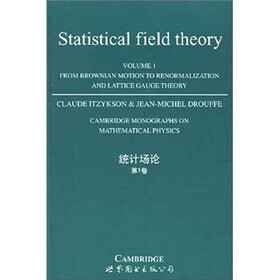
| Contents of Volume 2 Preface 1 From Brownian motion to Euclidean fields 1.1 Brownian motion 1.1.1 Random walks 1.1.2 The sum over paths 1.1.3 The dimension two of Brownian curves 1.2 Euclidean fields 1.2.1 Free fields 1.2.2 Interacting fields and random walks 1.2.3 Self-avoiding walks and the limit n → 0 1.2.4 Comparison with the high temperature expansion 1.2.5 The one-dimensional case 1.A Lattices Notes 2 Grassmannian integrals and the two-dimensional Ising model 2.1 Grassmannian integrals 2.1.1 Anticommuting variables 2.1.2 Integrals 2.2 The two-dimensional Ising model 2.2.1 Duality 2.2.2 Transfer matrix 2.2.3 Fermionic representation 2.2.4 Free energy 2.2.5 Spontaneous magnetization 2.2.6 Correlation function in the high temperature phase 2.2.7 Surface tension 2.3 Critical continuous theory 2.3.1 Effective action 2.3.2 Correlation functions 2.A Quadratic differences and Painleve equations Notes 3 Spontaneous symmetry breaking, mean field 3.1 Mean field approximation 3.1.1 Dielectric coastant of a polarizable medium 3.1.2 Classical spin model with a finite symmetry group 3.1.3 Continuous symmetry group 3.1.4 The Bethe approximation 3.1.5 Critical exponents 3.2 Lee-Yang zeroes 3.2.1 The Lee-Yang theorem 3.2.2 The one-dimensional case 3.2.3 General properties 3.2.4 Zeroes in the temperature plane 3.3 Large n limit 3.3.1 Saddle point method 3.3.2 Factorization 3.3.3 Coupling to an external field 3.4 Corrections to mean field 3.4.1 Laplace transform Notes 4 Scaling transformations and the XY-model 4.1 Scaling laws. Real space renormalization 4.1.1 Homogeneity and scale invariance 4.1.2 Recurrence relations in real space 4.1.3 Examples and approximations 4.2 The XY-model 4.2.1 High temperature behaviour 4.2.2 Low temperature expansion. Vortices 4.2.3 The Villain action 4.2.4 Correlations 4.2.5 Renormalization flow 4.A Two-dimensional systems with continuous symmetry 4.A.1 Magnetization inequality 4.A.2 Correlation inequality 4.B Phenomenological renormalization Notes 5 Continuous field theory and the renormalization group 5.1 The Lagrangian and dimensional analysis 5.1.1 Introduction 5.1.2 Generating functionals and dimensional analysis 5.2 The perturbative method 5.2.1 Diagrammatic series 5.2.2 Loop expansion 5.2.3 Evaluation of integrals and dimensional continuation 5.2.4 Group theoretical factors 5.2.5 Power counting 5.2.6 Perturbativc renormalization 5.3 The renormalization group 5.3.1 Renormalization flow 5.3.2 Critical exponents 5.3.3 From the Gaussian ultraviolet fixed point to the infrared critical point in dimension less than four 5.3.4 Correlation functions at the critical point 5.3.5 Expansion near the critical point 5.3.6 Scaling laws below the critical temperature 5.4 Corrections to scaling laws 5.4.1 Deviation from the critical point in dimension lower than four 5.4.2 Logarithmic corrections in dimension four 5.4.3 Irrelevant operators 5.5 Numerical results 5.5.1 e-expansion of critical exponents 5.5.2 Equation of state 5.5.3 Amplitude ratios 5.5.4 Three-dimensional results 5.A Multicritical points Notes 6 Lattice gauge fields 6.1 Generalities 6.1.1 Presentation 6.1.2 The continuous limit 6.1.3 Order parameter and Elitzur''s theorem 6.1.4 Duality 6.2 Structure of the phase diagram 6.2.1 Mean field approximation 6.2.2 Corrections to mean field and restoration of gauge invariance 6.2.3 Discrete groups: 1/d expansion 6.2.4 Continuous groups: computation of corrections 6.3 Strong coupling expansions 6.3.1 Convergence 6.3.2 Character expansions 6.3.3 Free energy 6.3.4 String tension and roughening transition 6.3.5 Mass spectrum 6.4 Lattice fermions 6.4.1 The doubling problem 6.4.2 The Nielsen-Ninomiya theorem 6.4.3 Staggered fermions Notes Index |




 内容加载中,请稍后...



商品评论(0条)