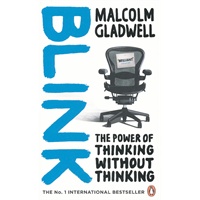
From Publishers Weekly
Starred
Review. Best-selling author Gladwell (The Tipping Point) has a
dazzling ability to find commonality in disparate fields of study.
As he displays again in this entertaining and illuminating look at
how we make snap judgments—about people's intentions, the
authenticity of a work of art, even military strategy—he can parse
for general readers the intricacies of fascinating but little-known
fields like professional food tasting (why does Coke taste
different from Pepsi?). Gladwell's conclusion, after studying how
people make instant decisions in a wide range of fields from
psychology to police work, is that we can make better instant
judgments by training our mind and senses to focus on the most
relevant facts—and that less input (as long as it's the right
input) is better than more. Perhaps the most stunning example he
gives of this counterintuitive truth is the most expensive war game
ever conducted by the Pentagon, in which a wily marine officer,
playing "a rogue military commander" in the Persian Gulf and
unencumbered by hierarchy, bureaucracy and too much technology,
humiliated American forces whose chiefs were bogged down in
matrixes, systems for decision making and information overload. But
if one sets aside Gladwell's dazzle, some questions and apparent
inconsistencies emerge. If doctors are given an algorithm, or
formula, in which only four facts are needed to determine if a
patient is having a heart attack, is that really educating the
doctor's decision-making ability—or is it taking the decision out
of the doctor's hands altogether and handing it over to the
algorithm? Still, each case study is satisfying, and Gladwell
imparts his own evident pleasure in delving into a wide range of
fields and seeking an underlying truth.
From Booklist
Gladwell writes about
subtle yet crucial behavioral phenomena with lucidity and
contagious enthusiasm. His first book, The Tipping Point (2000),
became a surprise best-seller. Here he brilliantly illuminates an
aspect of our mental lives that we utterly rely on yet rarely
analyze, namely our ability to make snap decisions or quick
judgments. Adept at bridging the gap between everyday experience
and cutting-edge science, Gladwell maps the "adaptive unconscious,"
the facet of mind that enables us to determine things in the blink
of an eye. He then cites many intriguing examples, such as art
experts spontaneously recognizing forgeries; sports prodigies; and
psychologist John Gottman's uncanny ability to divine the future of
marriages by watching videos of couples in conversation. Such feats
are based on a form of rapid cognition called "thin-slicing,"
during which our unconscious "draws conclusions based on very
narrow 'slices' of experience." But there is a "dark side of
blink," which Gladwell illuminates by analyzing the many ways in
which our instincts can be thwarted, and by presenting fascinating,
sometimes harrowing, accounts of skewed market research, surprising
war-game results, and emergency-room diagnoses and police work gone
tragically wrong. Unconscious knowledge is not the proverbial light
bulb, he observes, but rather a flickering candle. Gladwell's
groundbreaking explication of a key aspect of human nature is
enlightening, provocative, and great fun to read.
Donna Seaman
|



 内容加载中,请稍后...



商品评论(0条)