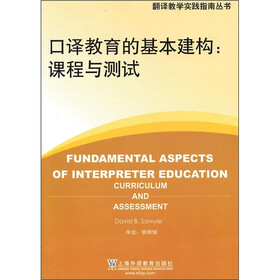
| Figures and tables Preface and acknowledgements CHAPTER 1 Introduction 1. Challenges facing interpreter education 2. The integrative role of assessment 3. The objectives of this book 4. Methodological considerations 5. Overview of contents CHAPTER 2 Interpreter education literature 1. Curriculum 2. Expertise 3. Assessment 4. Language transfer competence 5. Conclusions CHAPTER 3 Fundamental aspects of curriculum 1. Definitions 1.1 The official curriculum 1.2 The hidden curriculum 2. Foundations 2.1 Philosophy 2.2 History 2.3 Psychology 2.4 Sociology 3. Guidelines 3.1 Educational philosophy 3.2 The aims of instruction 3.3 Program goals 3.4 Teaching objectives 3.5 Curricular implications 4. Approaches 4.1 Scientific - curriculum as process 4.1.1 The computational view of the mind 4.1.2 Skills and abilities in Instructional Systems Design 4.1.3 The cognitive psychology of expertise 4.1.4 Levels of expertise in interpreting 4.1.5 Implications for curriculum sequencing 4.2 Humanistic - curriculum as interaction 4.2.1 A community of professional practice 4.2.2 Cognitive apprenticeship 4.2.3 Reflective practice 4.2.4 Situated cognition and learning 4.2.5 Implications for the learning environment 5. Models 5.1 Curriculum models according to Arjona 5.2 Curriculum components 6. Steps toward effective curriculum design 7. Conclusions CHAPTER 4 Foundations of interpreter performance assessment 1. Concepts 1.1 Validity 1.2 Reliability 1.3 Subjective and objective testing 1.4 Measurement scales 1.5 Formative, summative, and ipsative assessment 1.6 Test specifications 2. Integrating curriculum and assessment: Developmental milestones 2.1 Entry-level assessment 2.2 Intermediate assessment …… CHAPTER 5 Introduction to the case study CHAPTER 6 Case study Part I: Translation and interpretation competence CHAPTER 7 Case study Part II: Survey of exam jury members CHAPTER 8 Case study Part Ⅲ: Analysis of exam texts CHAPTER 9 Implications of the case study CHAPTER 10 Curriculum enhancement: An integrated Y-track model Outlook: On the political and ethical consequences of test validation Notes APPENDICES Appendix A Appendix B Appendix C References Name index Subject index |



 内容加载中,请稍后...



商品评论(0条)