Of all our great presidents, Theodore Roosevelt is the only one
whose greatness increased out of office. When he toured Europe in
1910 as plain “Colonel Roosevelt,” he was hailed as the most famous
man in the world. Crowned heads vied to put him up in their
palaces. “If I see another king,” he joked, “I think I shall bite
him.”
Had TR won his historic “Bull Moose” campaign in
1912 (when he outpolled the sitting president, William Howard
Taft), he might have averted World War I, so great was his
international influence. Had he not died in 1919, at the early age
of sixty, he would unquestionably have been reelected to a third
term in the White House and completed the work he began in 1901 of
establishing the United States as a model democracy, militarily
strong and socially just.
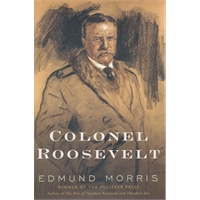
This biography by Edmund Morris, the Pulitzer
Prize and National Book Award–winning author of The Rise of
Theodore Roosevelt and Theodore Rex, is itself the completion of a
trilogy sure to stand as definitive. Packed with more adventure,
variety, drama, humor, and tragedy than a big novel, yet documented
down to the smallest fact, it recounts the last decade of perhaps
the most amazing life in American history. What other president has
written forty books, hunted lions, founded a third political party,
survived an assassin’s bullet, and explored an unknown river longer
than the Rhine?
Colonel Roosevelt begins with a prologue
recounting what TR called his “journey into the Pleistocene”—a
yearlong safari through East Africa, collecting specimens for the
Smithsonian. Some readers will be repulsed by TR’s bloodlust, which
this book does not prettify, yet there can be no denying that the
Colonel passionately loved and understood every living thing that
came his way: The text is rich in quotations from his marvelous
nature writing.
Although TR intended to remain out of politics
when he returned home in 1910, a fateful decision that spring drew
him back into public life. By the end of the summer, in his famous
“New Nationalism” speech, he was the guiding spirit of the
Progressive movement, which inspired much of the social agenda of
the future New Deal. (TR’s fifth cousin Franklin Delano Roosevelt
acknowledged that debt, adding that the Colonel “was the greatest
man I ever knew.”)
Then follows a detailed account of TR’s
reluctant yet almost successful campaign for the White House in
1912. But unlike other biographers, Edmund Morris does not treat TR
mainly as a politician. This volume gives as much consideration to
TR’s literary achievements and epic expedition to Brazil in
1913–1914 as to his fatherhood of six astonishingly different
children, his spiritual and aesthetic beliefs, and his eager
embrace of other cultures—from Arab and Magyar to German and
American Indian. It is impossible to read Colonel Roosevelt and not
be awed by the man’s universality. The Colonel himself remarked, “I
have enjoyed life as much as any nine men I know.”
Morris does not hesitate, however, to show how
pathologically TR turned upon those who inherited the power he
craved—the hapless Taft, the adroit Woodrow Wilson. When Wilson
declined to bring the United States into World War I in 1915 and
1916, the Colonel blasted him with some of the worst abuse ever
uttered by a former chief executive. Yet even Wilson had to admit
that behind the Rooseveltian will to rule lay a winning idealism
and decency. “He is just like a big boy—there is a sweetness about
him that you can’t resist.” That makes the story of TR’s last year,
when the “boy” in him died, all the sadder in the telling: the
conclusion of a life of Aristotelian grandeur.
|



 内容加载中,请稍后...


商品评论(0条)