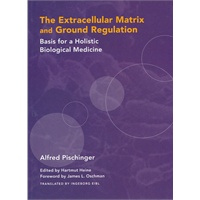
The workings of the suitable environment for cells--called the
extracellular matrix (ECM) and ground regulation--has occupied the
European medical tradition since the early part of the 20th
century. As it has become more clear that the origin of disease and
its first signals register in the connective tissue, or myofascia,
cellular pathologists and biochemists have sought to circumscribe
networks of cell communication and microcirculation in the ECM.
Alfred Pischinger (1899-1982) continued this line of work by
further studying, in work published from 1926 through the late
seventies, the connections of the ECM to the hormonal and autonomic
systems. In the last twenty years Professor and Doctor of Natural
Sciences Hartmut Heine and his colleagues have carried on
Pischinger's work, here summarized in one volume. Part One
encompasses theoretical underpinnings; Parts Two and Three address
applications and directions for further research. This updated
English-language translation not only is an account of the work of
Pischinger's successors--Heine, Otto Bergsmann, and Felix Perger,
(the three editors of this volume) and their many colleagues--but
notes the positive development of complementary therapies based on
this understanding of histology. Acupuncture is referenced
directly. Both in Europe and the States the work of manual
therapists, including Rolfers, cranio- sacral therapists, and other
somatic disciplines have been informed for many years by
Pischinger's outsider model of how changes in the EMC register in
the central nervous system and the brain, and are conveyed back to
the periphery and connected organs. Heine's exciting recent work
shows that the regulation and construction of the ECM have
relationships to cybernetic non-linear systems and phase
transitions.
|



 内容加载中,请稍后...


商品评论(0条)