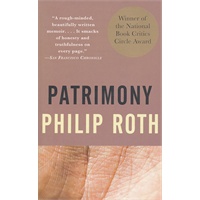
With the honesty of a skilled biographer and the sensitivity of a caring son, Roth chronicles the life of his father, Herman, in this gripping work which won a 1991 National Book Critics Circle Award. Roth holds little back in describing his father as a man of rare intensity and fierce independence who, for better or worse, stood by his principles and held others to his own rigorous standards. Writes Roth, "His obsessive stubbornness--his stubborn obsessiveness--had very nearly driven my mother to a breakdown in her final years." Frank throughout, Roth calls his father "a pitiless realist, but I wasn't his offspring for nothing, and I could be pretty realistic, too." |
In the 1990s Philip Roth won America's four major literary awards in succession: the National Book Critics Circle Award for Patrimony (1991), the PEN/Faulkner Award for Operation Shylock (1993), the National Book Award for Sabbath's Theater (1995), and the Pulitzer Prize in fiction for American Pastoral (1997). He won the Ambassador Book Award of the English-Speaking Union for I Married a Communist (1998); in the same year he received the National Medal of Arts at the White House. Previously he won the National Book Critics Circle Award for The Counterlife (1986) and the National Book Award for his first book, Goodbye, Columbus (1959). In 2000 he published The Human Stain, concluding a trilogy that depicts the ideological ethos of postwar America. For The Human Stain Roth received his second PEN/Faulkner Award as well as Britain's W. H. Smith Award for the Best Book of the Year. In 2001 he received the highest award of the American Academy of Arts and Letters, the Gold Medal in fiction, given every six years "for the entire work of the recipient." |


 内容加载中,请稍后...



商品评论(0条)