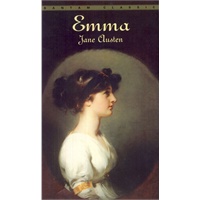
Book Description
Emma, when first published in 1816, was written when Jane Austen
was at the height of her powers. In it, we have her two greatest
comic creations — the eccentric Mr. Woodhouse and that
quintissential bore, Miss Bates. In it, too, we have her most
profound characterization: the witty, imaginative, self-deluded
Emma, a heroine the author declared "no one but myself will much
like," but who has been much loved by generations of readers.
Delightfull funny, full of rich irony, Emma is regarded as one of
Jane Austen's finest achievements.
Amazon.com
Of all Jane Austen's heroines, Emma Woodhouse is the most flawed,
the most infuriating, and, in the end, the most endearing. Pride
and Prejudice's Lizzie Bennet has more wit and sparkle; Catherine
Morland in Northanger Abbey more imagination; and Sense and
Sensibility's Elinor Dashwood certainly more sense--but Emma is
lovable precisely because she is so imperfect. Austen only
completed six novels in her lifetime, of which five feature young
women whose chances for making a good marriage depend greatly on
financial issues, and whose prospects if they fail are rather grim.
Emma is the exception: "Emma Woodhouse, handsome, clever, and rich,
with a comfortable home and happy disposition seemed to unite some
of the best blessings of existence; and had lived nearly twenty-one
years in the world with very little to distress or vex her." One
may be tempted to wonder what Austen could possibly find to say
about so fortunate a character. The answer is, quite a lot.
For Emma, raised to think well of herself, has such a high opinion
of her own worth that it blinds her to the opinions of others. The
story revolves around a comedy of errors: Emma befriends Harriet
Smith, a young woman of unknown parentage, and attempts to remake
her in her own image. Ignoring the gaping difference in their
respective fortunes and stations in life, Emma convinces herself
and her friend that Harriet should look as high as Emma herself
might for a husband--and she zeroes in on an ambitious vicar as the
perfect match. At the same time, she reads too much into a
flirtation with Frank Churchill, the newly arrived son of family
friends, and thoughtlessly starts a rumor about poor but beautiful
Jane Fairfax, the beloved niece of two genteelly impoverished
elderly ladies in the village. As Emma's fantastically misguided
schemes threaten to surge out of control, the voice of reason is
provided by Mr. Knightly, the Woodhouse's longtime friend and
neighbor. Though Austen herself described Emma as "a heroine whom
no one but myself will much like," she endowed her creation with
enough charm to see her through her most egregious behavior, and
the saving grace of being able to learn from her mistakes. By the
end of the novel Harriet, Frank, and Jane are all properly
accounted for, Emma is wiser (though certainly not sadder), and the
reader has had the satisfaction of enjoying Jane Austen at the
height of her powers.
--Alix Wilber
Amazon.co.uk Review
"I should like to see Emma in love, and in some doubt of return; it
would do her good," remarks one of Jane Austen's characters in
Emma.
Quick-witted, beautiful, headstrong and rich, Emma Woodhouse is
inordinately fond of match-making select inhabitants of the village
of Highbury, yet aloof and oblivious as to the question of whom she
herself might marry. This paradox multiplies the intrigues and
sparkling ironies of Jane Austen's masterpiece, her comedy of a
sentimental education through which Emma discovers a capacity for
love and marriage.
From Library Journal
This is another case where a classic is being reprinted simply as a
tie-in to a TV/feature film presentation. Libraries, nonetheless,
can benefit by picking up a quality hardcover for a nice price.
From AudioFile
The luxury of the unabridged edition requires a certain commitment.
But a luxury it is. Jenny Agutter's reading is perfectly suited to
the story, both in tone and pace. She brings out the comic insight
that is the hallmark of Austen's stories, making one laugh out loud
at times, so well has she caught the moment or the temperament of
the characters. The genius of Austen's wit often depends, not on
what is said, but on how it is said, and Agutter has given the
perfect voice to this lighthearted classic, delicately
differentiating each character's personality. A glorious way to
experience the essential Austen. K.R.
From 500 Great Books by Women; review by Chris Kellett
First published in 1816, Emma is generally regarded as Jane
Austen's most technically brilliant book. But that's not the reason
to read it. Read it to see how a scheming heiress who is determined
not to marry ends up embracing love and growing in maturity without
dying or becoming impossibly insipid, the fate of so many
nineteenth-century heroines. As her fourth novel was taking shape,
Jane Austen noted "I am going to take a heroine whom no one but
myself will much like." She was wrong. It is easy to love Emma
Woodhouse. She is a snob, a meddler, and a spoiled child - she is
also smart, funny, generous, and compassionate. Determined to
control the arrangements of other people's lives, Emma takes on the
self-appointed role of matchmaker in a world that grants little
public power to women. Small wonder that Emma, who has a "mind
lively and at ease," wastes her considerable creative powers
dreaming up romantic scenarios that consistently and comically fail
all reality checks. As in all of Jane Austen's works, the simple
theme of courtship belies the complexity of her vision of human
nature and of our need for power. Technical brilliance? Yes. Moral
brilliance? Most definitely. -- For great reviews of books for
girls, check out Let's Hear It for the Girls: 375 Great Books for
Readers 2-14.
From School Library Journal
Grade 7 Up. Starring Kate Beckinsale, this is the story of a rich,
clever and beautiful young woman who can't resist orchestrating
other people's love lives.
The New York Times, 2/15/97
"An 'Emma' Both Darker and Funnier"
"I am going to take a heroine whom no one but myself will much
like," Jane Austen wrote of Emma, vastly underestimating her
readers' good taste. The trick of adapting Emma is to recapture
Austen's delicate balance, which allows us to see why the heroine
still has friends and social influence, despite being the worst
matchmaker and busybody in the village of Highbury. In this smart
and spirited new version, Kate Beckinsale's Emma walks that fine
line beautifully. Her Emma meddles in her friends' lives with
near-disastrous results, and of course remains blind to her own
romantic feelings for her old friends Mr. Knightly. But her
sure-fire social assumptions are innocently wrong-headed, not
willfully arrogant.
In this and almost every other way, this new television film
called Jane Austen's Emma represents the flip side of last year's
movie with Gwyneth Paltrow. Though both are faithful to Austen's
plot, the earlier film was all about brightness and pretty gardens.
It was a slick commercial Emma, whose appeal depended on My.
Paltrow's graceful looks; not a bad idea, but not nearly what
Austen had in mind. Among the flood of recent Austen Movies, this
new Emma has the most in common with Persuasion, sharing a smaller
scale, a darker tone, and a focus on psychological nuance.
Ms. Beckensale's Emma is plainer looking than Ms. Paltrow's, and
altogether more believable and funnier. She came to the role well
prepared, after playing another socially self-assured comic figure
in the recent film Cold Comfort Farm.
The screenplay by Andrew Davies (who also did the wise
television adaptations of Pride and Prejudice and (Moll Flanders)
does a deft job of letting viewers pick up the social cures that
Emma misses. We see, as she should, the glances between the
eligible Frank Churchill and the poor Jane Fairfax. We can guess
that the clergyman Mr. Elton has designs on Emma and her dowry, not
on her penniless friend Harriet.
This version also makes it clear why Emma and Knightly are such
a good match. Like Ms. Beckinsale's Emma, Mark Strong's Knightly
does not have movie-star looks, but these two make excellent verbal
sparring partners, vehemently matching wits and social
observations. Prunella scales also stands out as Miss Bates, the
flibbertigibbet, motor-mouthed neighbor whom Emma callously insults
at a picnic.
Occasionally, this film plays out Emma's fantasies. There is a
brief glimpse of Harriet marrying Mr. Elton, and Frank Churchill's
portrait comes alive and speaks to Emma, saying, "Miss Woodhouse,
we meet at last." The device is used just enough to add an
imaginative touch without becoming a useless gimmick.
After so many Austen films, it would be easy to overlook this
latest, but its charms are those Austen herself might have valued.
It is understated and sly, loaded with a sense that even as society
as well-ordered as Emma's leaves plenty of room for comic
misjudgments and happy endings.
Book Dimension:
length: (cm)17.1 width:(cm)10.2
|



 内容加载中,请稍后...



商品评论(0条)