One of the English language’s most skilled
and beloved writers guides us all toward precise, mistake-free
usage.
As usual Bill Bryson says it best: “English is a
dazzlingly idiosyncratic tongue, full of quirks and irregularities
that often seem willfully at odds with logic and common sense. This
is a language where ‘cleave’ can mean to cut in half or to hold two
halves together; where the simple word ‘set’ has 126 different
meanings as a verb, 58 as a noun, and 10 as a participial
adjective; where if you can run fast you are moving swiftly, but if
you are stuck fast you are not moving at all; [and] where
‘colonel,’ ‘freight,’ ‘once,’ and ‘ache’ are strikingly at odds
with their spellings.” As a copy editor for the London Times in the
early 1980s, Bill Bryson felt keenly the lack of an
easy-to-consult, authoritative guide to avoiding the traps and
snares in English, and so he brashly suggested to a publisher that
he should write one. Surprisingly, the proposition was accepted,
and for “a sum of money carefully gauged not to cause embarrassment
or feelings of overworth,” he proceeded to write that book–his
first, inaugurating his stellar career.
Now, a decade and a half later, revised,
updated, and thoroughly (but not overly) Americanized, it has
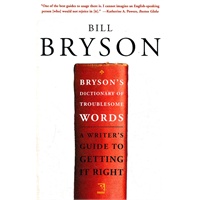
become Bryson’s Dictionary of Troublesome Words, more than ever an
essential guide to the wonderfully disordered thing that is the
English language. With some one thousand entries, from “a, an” to
“zoom,” that feature real-world examples of questionable usage from
an international array of publications, and with a helpful glossary
and guide to pronunciation, this precise, prescriptive, and–because
it is written by Bill Bryson–often witty book belongs on the desk
of every person who cares enough about the language not to maul or
misuse or distort it.
From the Hardcover edition.
|




 内容加载中,请稍后...



商品评论(0条)