A masterpiece of implicitness . . . explicitly concerned with
drawing out the metaphysical-private while keeping it embedded in
society and history . . . The ironies in Half a Life wind
like a fugue into infinity . . . Identity is an enigma . . . To
make that sentiment breathe in the mouth of a living character, and
then rise from the page with silent laughter, is a beautiful
completion: the mark of a genius and a cause of unending delight. ?
Lee Siegel, Los Angeles Times Book Review
"As disquieting as anything [Naipaul] has ever written . . . His
terse prose works, as always, to imply a world in a phrase." ?
Michael Gorra, New York Times Book Review
"A troubling novel, genuinely moving . . . disturbing in all the
right ways . . . the scenes of social encounters are brilliant, set
against the twilight of colonial rule . . . A stunning book, three
continents, three journeys, the evergreen themes of caste and
class, of growing up." ? Betsy Willeford, Miami Herald
"Naipaul's style is so frank it seems intimate, and the awful
characters are studied and well crafted. Behind the matter-of-fact
style is a cuttingly ironic view of human relations . . . When
Naipaul talks, we listen." ? Diane Mehta, The Atlantic
Monthly
"Naipaul is a master of English prose, and the prose of Half a
Life is as clean and cold as a knife." ? J. M. Coetzee, New
York Review of Books
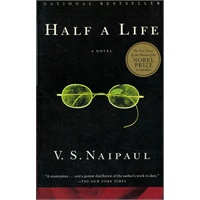
"'Half a Life,' the fierce new novel by V. S. Naipaul, the new
Nobel laureate, is one of those rare books that stands as both a
small masterpiece in its own right and as a potent distillation of
the author's work to date . . . It deftly combines Dickensian
delight in character with political and social observation . . .
while recounting with uncommon elegance and acerbity the coming of
age of its hero, Willie Chandran ... Mr. Naipaul endows his story
with the heightened power of a fable. With 'Half a Life' he has
given us a powerful tale of one man's journey from childhood to
middle age while at the same time creating a resonant parable about
the convulsions of modern history, both the dying of old inequities
and the rise of new illusions, and their spiritual legacy of
homelessness and dislocation." ? Michiko Kakutani, New York
Times
"As sly and funny as anything Naipaul has written . . .
He is still mining his richest obsessions . . . The classic that
his new novel calls to mind is Voltaire's Candide. There is
the same mocking simplicity of style, the same heartless elegance
of design . . . Nobody who enjoys seeing English beautifully
controlled should miss this novel." ? John Carey, Sunday
Times
"A surprise and a pleasure . . . here, at last, is a work of pure
imagination, though the themes are characteristic in their complex
peculiarity . . . Naipaul has produced the most complex and
demanding body of work of any post-war British writer . . . In
sentences of great precision and balance, Naipaul reanimates the
dilemmas of the late and post-colonial experience . . . He reminds
us again of what a fine and unusual writer he is . . . In the canon
of contemporary British writing he is without peer: a cold,
clear-eyed prophet, a scourge of sentimentality, irrationalism and
lazy left-liberal prejudices. Read him." ? Jason Cowley, The
Observer Review
"Naipaul writes a prose as clean as a stripped wand, but however
plain the language, the ideas it delivers are not. . . . He is
still peerless as a deviser of the shocking icon. He builds a scene
of metaphysical loss as compelling as any Renaissance canvas of the
expulsion from paradise." ? Paula Burnett, The
Independent
"No writer has written more tellingly about the vocation of writing
than V. S. Naipaul. . . . this new novel, Half a Life, shows
us that Naipaul's absorption in how he came to be a writer is still
fresh. . . . The pages about London glow, and bear comparison with
anything that Naipaul has done . . . Almost casually, but
beautifully, achieved . . . Captures in miniature the exceptional
trajectory of Naipaul's oeuvre-the figure of the father, the life
of the writer, and, finally, an enquiry into the origins of the
colonial landscape itself." ? Amit Chaudhuri, Times Literary
Supplement
"The foremost literary interpreter of the third world for a British
and American readership." ? Maya Jaggi, The Guardian
"Genuinely powerful in a deeply politically incorrect way." ?
Jonathan Bate, Daily Telegraph
"Fresh . . . A novel with a purpose . . . Through the evocation of
three continents and several decades, without calling on public
events and purely through the narrative of a life, V. S. Naipaul
gives us a moral tale which captures the evanescence of our times."
? Farrukh Dhondy, Literary Review
"Read it for its beautifully controlled English." ? The Sunday
Times
"One of the world's greatest living novelists . . . A writer whose
world-view has been characterised by rigorous inquiry . . . A
fascinating study . . . Naipaul has thankfully lost none of his
grace, style, or storytelling power in this beautiful novel." ?
Stuart Price, Independent
"Like a series of musical variations, the novel that follows [the
first lines] never departs from them in essence . . . This is
brilliant, affecting stuff: the novel's melancholy drama is played
out on the furthest margins of fiction, where things are
recollected rather than observed." ? Rachel Cusk, Evening
Standard
"Naipaul's first novel in six years is another installment in the
extended fictional autobiography. . . . [This novel] may tell us
more about the essential Naipaul than he has ever heretofore
revealed. . . . The work of a master who has rarely, if ever,
written better." ? Kirkus Reviews (starred review)
From the Hardcover edition. -- Review
|





 内容加载中,请稍后...


商品评论(0条)