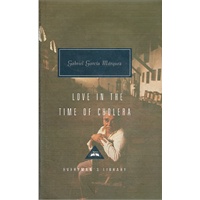
From Publishers Weekly
The ironic vision
and luminous evocation of South America that have distinguished
Garcia Marquez's Nobel Prize-winning fiction since his landmark
work, One Hundred Years of Solitude, persist in this
turn-of-the-century chronicle of a unique love triangle. It is a
fully mature novel in scope and perspective, flawlessly translated,
as rich in ideas as in humanity. The illustrious and meticulous Dr.
Juvenal Urbino and his proud, stately wife Fermina Daza,
respectively past 80 and 70, are in the autumn of their solid
marriage as the drama opens on the suicide of the doctor's chess
partner. Jeremiah de Saint-Amour, a disabled photographer of
children, chooses death over the indignities of old age, revealing
in a letter a clandestine love affair, on the "fringes of a closed
society's prejudices." This scenario not only heralds Urbino's
demise soon afterwhen he falls out of a mango tree in an attempt to
catch an escaped parrotbut brilliantly presages the novel's central
themes, which are as concerned with the renewing capacity of age as
with an anatomy of love. We meet Florentino Ariza, more antihero
than hero, a mock Don Juan with an undertaker's demeanor, at once
pathetic, grotesque and endearing, when he seizes the memorably
unseemly occasion of Urbino's funeral to reiterate to Fermina the
vow of love he first uttered more than 50 years before. With the
fine detailing of a Victorian novel, the narrative plunges backward
in time to reenact their earlier, youthful courtship of furtive
letters and glances, frustrated when Fermina, in the light of
awaking maturity, realizes Florentino is an adolescent obsession,
and rejects him. With his uncanny ability to unearth the
extraordinary in the commonplace, Garcia Marquez smoothly
interweaves Fermina's and Florentino's subsequent histories.
Enmeshed in a bizarre string of affairs with ill-fated widows while
vicariously conducting the liaisons of others via love poems
composed on request, Florentino feverishly tries to fill the void
of his unrequited passion. Meanwhile, Fermina's marriage suffers
vicissitudes but endures, affirming that marital love can be as
much the product of art as is romantic love. When circumstances
both comic and mystical offer Fermina and Florentino a second
chance, during a time in their lives that is often regarded as
promising only inevitable degeneration toward death, Garcia Marquez
beautifully reveals true love's soil not in the convention of
marriage but in the simple, timeless rituals that are its cement.
100,000 first printing; first serial to the New Yorker; BOMC main
selection.
Copyright 1988 Reed Business Information, Inc. --This text refers
to the Hardcover edition.
From Library Journal
While delivering a message to her father, Florentino Ariza spots
the barely pubescent Fermina Daza and immediately falls in love.
What follows is the story of a passion that extends over 50 years,
as Fermina is courted solely by letter, decisively rejects her
suitor when he first speaks, and then joins the urbane Dr. Juvenal
Urbino, much above her station, in a marriage initially loveless
but ultimately remarkable in its strength. Florentino remains
faithful in his fashion; paralleling the tale of the marriage is
that of his numerous liaisons, all ultimately without the depth of
love he again declares at Urbino's death. In substance and style
not as fantastical, as mythologizing, as the previous works, this
is a compelling exploration of the myths we make of love. Highly
recommended. Barbara Hoffert, "Library Journal"
|





 内容加载中,请稍后...


商品评论(0条)