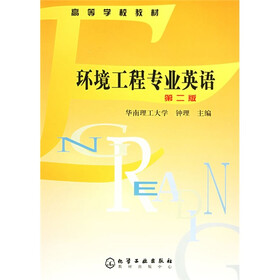
| 《环境工程专业英语》是根据《大学英语教学大纲》(理工科本科用)专业阅读部分的要求编写的,供理工科大学环境工程或相关专业学生使用,也可供同等英语程度环境工程师或相关领域的科技人员使用。为便于学生自学,《环境工程专业英语》每课配有单词和词组表,并对课文的难点作必要的注释,全书最后附有总词汇表。 |
| 钟理 华南理工大学化工与能源学院教授。主要从事化学工艺及水处理研究。 |
| PART 1 INTRODUCTION TO ENVIRONMENTAL ENGINEERING1 Unit 1 Text: Environmental Engineering1 Reading Material: Studying the Environment4 Unit 2 Text: Historical Overview of Hazardous Substance Disposal in the USA8 Reading Material: The City Environment11 Unit 3 Text: What is Waste Reduction/Waste Minimization?14 Reading Material: Waste Minimization in the Chemical Industry——A Case Study19 Unit 4 Text: Environmental Analysis25 Reading Material: Analytical Technique and Methodology28 PART 2 AIR POLLUTION & CONTROL32 Unit 5 Text: Type and Sources of Air Pollutants[I]32 Reading Material: Type and Sources of Air Pollutants[II]34 Unit 6 Text: Effects on Climate and Ecological Environment[I]37 Reading Material: Effects on Climate and Ecological Environment[II]41 Unit 7 Text: Conventional Technology of Air pollution Control44 Reading Material: Gas and Vapor Control Technology48 Unit 8 Text: New Technologies of Air Pollution Control[I]50 Reading Material: New Technologies of Air Pollution Control[II]54 Unit 9 Text: Effects of Air Pollution57 Reading material: Control of Air Pollution by Oxidation60 PART 3 WATER POLLUTION AND WASTEWATER TREATMENT63 Unit 10 Text: Water Pollution and Pollutants63 Reading Material: Wastewater66 Unit 11 Text: Pollution of Inland Waters and Oceans69 Reading Material: Water Supply73 Unit 12 Text: Water Purification78 Reading Material: Principles of Wastewater Treatment81 Unit 13 Text: Water Treatment Processes85 Reading Material: USWastewater Treatment——Past and Present89 Unit 14 Text: Biological Wastewater Treatment [I]91 Reading material: Biological Wastewater Treatment[II]95 Unit 15 Text: Ion Exchange99 Reading Material: Precipitation104 Unit 16 Text: Oxidation of Wastewater[I]108 Reading Material: Oxidation of Wastewater [II]111 Unit 17 Text: Unit Operations of Pretreatment116 Reading Material: Unit Processes of Secondary Treatment120 PART 4 SOLID WASTES AND DISPOSAL123 Unit 18 Text: Sources and Types of Solid Wastes123 Reading Material: Quantities of Wastes127 Unit 19 Text: Everybody’s Problems——Hazardous Waste130 Reading Material: Hazardous Waste Defined and the National Program to Control Hazardous Wastes134 Unit 20 Text: Methods of Waste Disposal137 Reading Material: Incineration of Hazardous Waste in the USA140 Unit 21 Text: Disposal of Solid Wastes144 Reading Material: Materials and Energy Recovery148 PART 5 OTHER POLLUTION AND CONTROL TECHNOLOGIES152 Unit 22 Text: Sound and Noise152 Reading Material: Tone and the Decibel Scale154 Unit 23 Text: Noise Control[I]156 Reading Material: Noise Control[II]157 Unit 24 Text: Energy Consumption and Pollution162 Reading Material: Use of Solar Energy164 Unit 25 Text: Thermal Pollution166 Reading Material: How to Put Waste Heat to Good Use167 PART 6 ENVIRONMENTAL IMPACT ASSESSMENT169 Unit 26 Text: Summary of EIA169 Reading material: Introduction to Methods for Environmental Impact Assessment172 Unit 27 Text: Impact of Wastewater Effluents on Water Quality of River177 Reading Material: The Aims and Objectives of Environmental Impact Assessment179 Unit 28 Text: Environmental Impact Assessment of Air Quality185 Reading Material: Identification and Prediction of Air Quality Changes187 PART 7 ENVIRONMENTAL MONITORING190 Unit 29 Text: Monitoring Air Quality in Mountains——Designing190 Reading Material: Design Environmental Databases for Statistical Analysis194 Unit 30 Text: Combining Accuracy Assessment of Land-Cover Maps with Environmental Monitoring Programs[I]199 Reading Material: Combining Accuracy Assessment of Land-Cover Maps with Environmental Monitoring Programs[III]204 Unit 31 Text: Sampling Sediment and Soil209 Reading Material: EMAP Overview-Objectives, Approaches, and Achievements213 PART 8 ENVIRONMENTAL POLICY AND MANAGEMENT218 Unit 32 Text: A New Politics for a New Era——A Political Agenda for the 1990s218 Reading Material: Hazardous Waste Management224 Unit 33 Text: Pollution Control Strategies[I]228 Reading Material: Pollution Control Strategies[II]230 Unit 34 Text: Solid Waste Management Overview235 Reading Material: Management of Nuclear Wastes239 PART 9 ENVIRONMENTAL SUSTAINABLE DEVELOPMENT243 Unit 35 Text: Clean Technologies through Microbial Processes for Economic Benefits and Sustainability[I]243 Reading Material: Clean Technologies through Microbial Processes for Economic Benefits and Sustainability[II]247 Unit 36 Text: Introduction to Green Chemical Syntheses and Processes251 Reading Material: Water as Solvent for Organic and Material Synthesis255 Unit 37 Text: Wastewater Treatment, Greenhouse Gas Mitigation and Hydrogen Production Using Microalgae[I]259 Reading Material: Wastewater Treatment, Greenhouse Gas Mitigation and Hydrogen Production Using Microalgae[II]263 GLOSSARY268 |
 内容加载中,请稍后...



商品评论(0条)