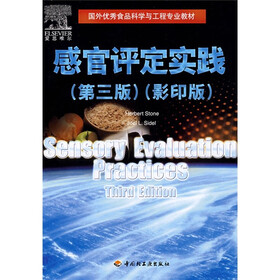
| In this Third Edition of Sensory Evaluation Practices, the authors, Herbert Stone and Joel L. Sidel, draw from their extensive experience to provide readers with the back-ground and understanding necessary to make informed decisions about developing and managing a sensory program. In this edition, the authors provide more current information about the applications for sensory information and operating in a more expanded business environment. In I974, Stone and Sidel founded Tragon Corporation, an important sensory and consulting company offering full-service consumer goods research. As a pioneering company in the field of sensory evaluation, Tragon has been able to offer unparal- leled capabilities to its customers through the Quantitative Descriptive Analysis (QDA) sensory method, and Product Optimization (PROP) marketing and sensory modeling method, much greater insight into driving consumer purchase behavior. Cumulatively, the authors have more than half a century of experience in the field of sensory evaluation and its business applications. In addition to founding Tragon Corporation, the authors have conducted domestic and international workshops; designed and analyzed, and reported on thousands of sensory tests; and have been consultants to the senior management of many major food and consumer products companies. In 2003, Herbert Stone was elected President (for the period 2003-2005) 0fthe Institute of Food Technologists. |
| 写在前面的话 第一版序言 第二版序言 第三版序言 作者介绍 1.感官评定引论 Ⅰ.引言和目的 Ⅱ.历史背景 Ⅲ.感官评定的发展 Ⅳ.感官评定的定义 Ⅴ.生理学和心理学概述 2.感官评定活动的组织与实施 Ⅰ.引言 Ⅱ.感官评定活动的组织 Ⅲ.结论 3.测量 Ⅰ.引言 Ⅱ.测定的元素:范围 Ⅲ.选择测定技术 Ⅳ.结论 4.测试策略和实验设计 Ⅰ.引言 Ⅱ.测试要求与目的 Ⅲ.产品标准 Ⅳ.心理偏差 Ⅴ.统计学需考虑的因素 Ⅵ.实验设计需考虑的因素 Ⅷ.选择产品设计 5.差别试验 Ⅰ.引言 Ⅱ.方法 Ⅲ.测试所包括的内容 Ⅳ.特殊问题 Ⅴ.总结 6.描述试验 Ⅰ.引言 Ⅱ.测试方法 Ⅲ.描述分析的应用 Ⅳ.结论 7.接受性测试 Ⅰ.引言 Ⅱ.方法 Ⅲ.主题 Ⅳ.接受性测试方法 Ⅴ.特殊问题 Ⅵ.结论 8.特殊问题 Ⅰ.引言 Ⅱ.仪器与感官之间的关系 Ⅲ.专家与专业评定小组 Ⅳ.感官的效果与广告宣传 Ⅴ.稳定性试验 Ⅵ.产品开发 Ⅷ.质量控制 Ⅷ.优化 Ⅸ.结论 结语 Ⅰ.引言 Ⅱ.教育和感官专业 Ⅲ.将来发展 参考资料 索引 |


 内容加载中,请稍后...




商品评论(0条)