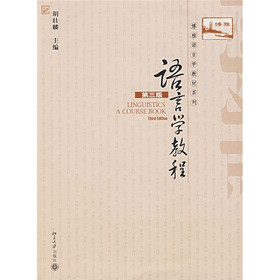
| 其他版本请见:《21世纪英语专业系列教材:语言学教程(第4版)》 《语言学教程》分为两大部分,十六章,第一部分主要介绍了语言起源及内部各层次;第二部分详细地阐述了讲授语言在时空中的变异及其与思维、文化、社会、语境、文学等外部因素的关系。此外,本书还包涵有两个附录,分别讨论语言学与教学的关系和当代语言学中的重要流派。 |
| 胡壮麟,语言学家,北京大学英语系教授,中国语言与符号学研究会会长。上海人。出版有《语言学教程》、《系统功能语法概论》、《当代语言理论与应用》等。 |
| Chapter 1 Invitations to Linguistics 1.1 Why Study Language? 1.2 What Is Language? 1.3 Design Features of Language 1.4 Origin of Language 1.5 Functions of Language 1.6 What Is Linguistics? 1.7 Main Branches of Linguistics 1.8 Macrolinguistics 1.9 Important Distinctions in Linguistics Further Reading Chapter 2 Speech Sounds 2.1 How Speech Sounds Are Made? 2.2 Consonants and Vowels 2.3 From Phonetics to Phonology 2.4 Phonological Processes,Phonological Rules and Distinctive Features 2.5 Suprasegmentals Further Reading Chapter 3 Lexicon 3.1 What Is Word? 3.2 The Formation of Word Further Reading Chapter 4 From Word to Text 4.1 Syntactic Relations 4.2 Grammatical Construction and Its Coonstituents 4.3 Syntactic Function 4.4 Category 4.5 Phrase Clause and Sentence 4.6 Recursiveness 4.7 Beyond the Sentence Further Reading Chapter 5 Meaning 5.1 Meanings of“MEANING” 5.2 The Referential Theory 5.3 Sense Relations 5.4 Componential Analysis 5.5 Sentence Meaning Further Reading Chapter 6 Language and Cognition 6.1 What Is Cognition? 6.2 What Is Psycholinguistics? 6.3 What Cognitive Linguistics? Further Reading Chapter 7 Language,Culture,and Society Chapter 8 Language in Use Chapter 9 Language and Literature Chapter 10 Language and Computer Chapter 11 Linguistics and Foreign Language Teaching Chapter 12 Theories and Schools of Modern Linguistics Questions and Exercises Bibliography Glossary and Index |


 内容加载中,请稍后...



商品评论(0条)