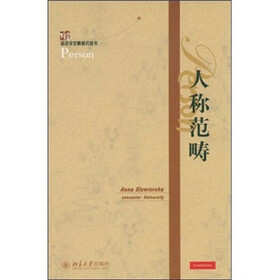
| 《人称范畴》是迄今为止第一部全面系统的研究人称范畴的著作,通过对七百多种语言中第一、二、三人称词作跨语言调查,作者比较其不同的表现,并发现不同的表现背后的原因。他还研究了人称词形式在语言中的使用情况,人称词之间的语义区别的性质,在句子和篇章中怎样使用及其不同的社会意义。通过调查人称形式的不同语法和其使用的语境,《人称范畴》鲜明反对了从形态和句法性质等任意性角度对人称词进行的研究。 |
| List of figures List of tables Preface List of abbreviations 1 Introduction 1.1 Person as a grammatical category 1.1.1 Person paradigms 1.1.2 First and second persons vs third person 1.2 The universality of person markers 1.3 The nature of this book 2 The typology of person forms 2.1 Morpho-phonological form 2.1.1 Independent forms 2.1.2 Dependent person markers 2.2 Syntactic function 2.2.1 Syntactic function and morpho-phonological form 2.2.2 The encoding of syntactic function 2.3 Discourse function 3 The structure of person paradigms 3.1 Fewer than three persons 3.2 Variation with respect to number 3.2.1 More than one person and the inclusive/exclusive distinction 3.2.2 Duals and larger numbers 3.2.3 Number and the person hierarchy 3.2.4 Towards a typology of paradigmatic structure 3.3 Variation in gender 3.3.1 Gender and the person hierarchy 3.3.2 Gender and number 3.3.3 Gender and the inclusive/exclusive distinction 3.4 Differences between paradigms 3.4.1 Independent w dependent paradigms 3.4.2 Differences between dependent forms 4 Person agreement 4.1 Anaphoric pronoun vs person agreement marker 4.2 The targets of person agreement 4.2.1 Predicates 4.2.2 Possessed nouns 4.2.3 Adpositions and other targets 4.3 The controllers of person agreement 4.3.1 The person hierarchy 4.3.2 The nominal hierarchy 4.3.3 The animacy hierarchy 4.3.4 The referential hierarchy 4.3.5 The focus hierarchy 4.4 The markers of person agreement 4.4.1 Person agreement and morpho-phonological form 4.4.2 The location of person markers 5 The function of person forms 5.1 Cognitive discourse analysis and referent accessibility 5.2 Referent accessibility and the distribution of person forms in discourse 5.2.1 Entity saliency 5.2.2 Unity 5.3 Accessibility and the intra-sentential distribution of person forms 5.3.1 Chomskys Binding Theory 5.3.2 Referent accessibility and BT 5.3.3 The avoid pronoun constraint 5.4 Beyond referent accessibility 5.4.1 Long-distance reflexives, logophoricity and point of view 5.4.2 Person marker vs other referential expression and speaker empathy 5.5 Person markers and impersonalization 6 Person forms and social deixis 6.1 Alternation in semantic categories 6.1.1 Variation in number 6.1.2 Variation in person 6.1.3 The use of reflexives 6.2 Special honorific person markers 6.3 Omission of person markers 7 Person forms in a diachronic perspective 7.1 The sources of person markers 7.1.1 Lexical sources 7.1.2 Demonstratives 7.1.3 Other person markers 7.1.4 Conjugated verbal forms 7.1.5 Other grammatical markers 7.2 From independent person marker to syntactic agreement marker 7.2.1 Three accounts of the early stages of the grammaticalization of person markers 7.2.2 Syntactic agreement markers 7.3 Language externally driven changes in person marking 7.3.1 Borrowing of person markers 7.3.2 Loss of person agreement Appendix 1. List of languages in the sample by macro-area Appendix 2. Genetic classification of languages cited in the text References Author index Language index Subject index |



 内容加载中,请稍后...



商品评论(0条)