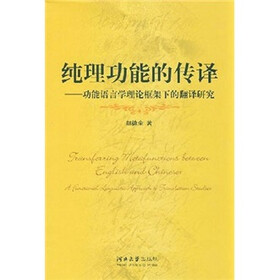
| Foreword Chapter 1 Introduction 1.1 Introduction 1.2 Theoretical bases 1.2.1 Systemic analysis on attempted texts 1.2.2 Traditional Chinese translation theory 1.2.3 Contemporary western theories 1.3 The statement of the problems 1.4 The goals of the study 1.5 The scope of the study 1.6 Procedures 1.7 The outline of the study Chapter 2 Faithfulness and Equivalence 2.1 Introduction 2.2 Faithfulness 2.2.1 The early concept of faithfulness in translation 2.2.2 Xuan Zang's faithfulness 2.2.3 Translation practice following the Tang dynasty 2.2.4 Yan Fu's faithfulness 2.2.5 Translation theory in present China 2.3 Equivalence 2.3.1 Nida's concept of equivalence 2.3.2 Catford and translation equivalence 2.4 Systemic view On translation and equivalence 2.5 Summary Chapter 3 Transferring Ideational Function 3.1 Introduction 3.2 Systemic functional perspective on languages 3.3 Metafunctions 3.4 Ideational functions and transitivity system 3.5 Preservation of ideational components 3.6 Ideational components in poetry 3.7 Shifts in translation 3.7.1 Order shifts 3.7.2 Rank shift 3.7.3 Structure shift 3.8 Summary Chapter 4 Transferring Interpersonal Function 4.1 Introduction 4.2 Interpersonal function of language 4.2.1 Speech functions 4.2.2 Constituents of the mood 4.2.3 Constituents of the residue 4.2.4 Modality 4.3 Transferring interpersonal function 4.3.1 The interpersonal meaning in the ideational content 4.3.2 Prioritized interpersonal function 4.3.3 Transferring interpersonal function in opera translation 4.3.4 Transferring interpersonal function in novel translation 4.4 The balance between ideational function and interpersonal function 4.5 Summary Chapter 5 Transferring Textual Function 5.1 Introduction 5.2 Textual function of languages 5.2.1 Theme and rheme 5.2.2 Given and new 5.2.3 Cohesion and coherence 5.3 Transferring textual function 5.3.1 Theme-rheme system in translation 5.3.2 Information system in translation 5.3.3 Focus-shifts in translation 5.3.4 Cohesion and coherence in translation 5.4 Summary Chapter 6 Literal Translation and Free Translation 6.1 Introduction 6.2 Traditional concepts of literal and free translation 6.2.1 Early concepts of literal and free translation in China 6.2.2 Xuan Zang's strategy in Buddhist translation 6.2.3 Yan Fu-a practitioner of free translation 6.2.4 Lu Xu's adherence to the literal translation 6.2.5 Concepts of literal translation and free translation in western countries 6.2.6 Xu Yuanchong's summary on literal and free translation 6.3 Functional perspective on literal and free translation 6.3.1 Nature of literal and free translation 6.3.2 Automatization and de-automatization 6.3.3 Transferring ideational function: from literal translation to free translation 6.4 Summary Chapter 7 Conclusion 7.1 Introduction 7.2 Questions involved 7.3 Major findings 7.4 Implications and applications 7.5 Limitations and suggestions Bibbiography |

 内容加载中,请稍后...



商品评论(0条)