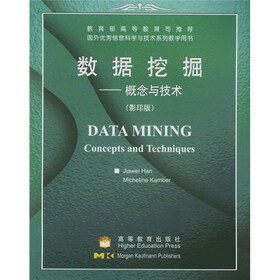
| Jiawei Han is director of the Intelligent Database Systems research Laboratory and professor in the School of Computing Science at Simon Fraser University.Well dnown for his research in the areas of data mining and data-base systems,he has served on program committees for dozens of international conferences and workshops and on editorial boards for several journals,including IEEE Transactiona on Knowledge and Data Engineering and Data Mining and Knowledge Discovery. Micheline Damber is a researcher adn freelance technical writer with an M.S.in computer science.She is a member of the Intelligent Database Systems Research Laboratory at Simon Fraser University. |
| Foreword Preface Chapter 1 Introduction 1.1 What Motivated Data Mining? Why is it important? 1.2 So,What is Data Mining? 1.3 Data Mining-On What Kind of Data? 1.3.1 Relational Databases 1.3.2 Data Warehouses 1.3.3 Transactional Databases 1.3.4 Advanced Database Systems and Advanced Database Applications 1.4 Data Mining Functionalities-What Kinds of Patterns Can Be Mined? 1.4.1 Concept/Class Description:Characterization and Discrimination 1.4.2 Association Analysis 1.4.3 Classification and Prediction 1.4.4 Cluster Analysis 1.4.5 Outlier Analysis 1.4.6 Evolution Analysis 1.5 Are All of the Patterns Interesting? 1.6 Classification of Data Mining Systems 1.7 Major Issues In Data Mining 1.8 Summary Exercises Bibliographic Notes Chapter 2 Data Warehouse and OLAP Technology for Data Mining 2.1 What is a Data Warehouse? 2.1.1 Differences between Operational Database Systems and Data Warehouses 2.1.2 But, Why Have a Separate Data Warehouse? 2.2 A Multidimensional Data Model 2.2.1 From Tables and Spreadsheets to Data Cubes 2.2.2 Stars, Snowflakes,and Fact Constellations:Schemas for Multidimensional Databases 2.2.3 Examples for Defining Star, Snowflake, and Fact Constellation Schemas 2.2.4 Measures:Their Categorization and Computation 2.2.5 Introducing Concept Hierarchies 2.2.6 OLAP Operations in the Multidimensional Data Model 2.2.7 A Starnet Query Model for Querying Multidimensional Databases 2.3 Data Warehouse Architecture 2.3.1 Steps for the Design and Construction Of Data Warehouses 2.3.2 A Three-Tier Data Warehouse Architecture 2.3.3 Types of OLAP Servers:ROLAP versus MOLAP versus HOLAP 2.4 Data Warehouse Implementation 2.4.1 Efficient Computation of Data Cubes 2.4.2 Indexing OLAP Data 2.4.3 Efficient Processing of OLAP Queries 2.4.4 Metadata Repository 2.4.5 Data Warehouse Back-End Tools and Utilities 2.5 Further Development of Data Cube Technology 2.5.1 Discovery-Driven Exploration of Data Cubes 2.5.2 Complex Aggregation at Multiple Granularities:Multifeature Cubes 2.5.3 Other Developments 2.6 From Data Warehousing to Data Mining 2.6.1 Data Warehouse Usage 2.6.2 From On-Line Analytical Processing to On-Line Analytical Mining 2.7 Summary Exercises Bibliographic Notes Chapter 3 Data Preprocessing 3.1 Why Preprocess the Data? 3.2 Data Cleaning 3.2.1 Missing Values 3.2.2 Noisy Data 3.2.3 Inconsistent Data 3.3 Data Integration and Transformation 3.3.1 Data Integration 3.3.2 Data Transformation 3.4 Data Reduction 3.4.1 Data Cube Aggregation 3.4.2 Dimensionality Reduction 3.4.3 Data Compression 3.4.4 Numerosity Reduction 3.5 Discretization and Concept Hierarchy Generation 3.5.1 Discretization and Concept Hierarchy Generation for Numeric 3.5.2 Concept Hierarchy Generation for Categorical Data 3.6 Summary Exercises Bibliographic Notes Chapter 4 Data Mining Primitives, Languages, and System Architectures 4.1 Data Mining Primitives: What Defines a Data Mining Task? 4.1.1 Task-Relevant Data 4.1.2 The Kind of Knowledge to be Mined 4.1.3 Background Knowledge: Concept Hierarchies 4.1.4 Interestingness Measures 4.1.5 Presentation and Visualization of Discovered Patterns 4.2 A Data Mining Query Language 4.2.1 Syntax for Task-Relevant Data Specification 4,2.2 Syntax for Specifying the Kind of Knowledge to be Mined 4.2.3 Syntax for Concept Hierarchy Specification 4.2.4 Syntax for Interestingness Measure Specification 4.2.5 Syntax for Pattern Presentation and Visualization Specification 4.2.6 Putting it All Together-An Example of a DMQL Query 4.2.7 Other Data Mining Languages and the Standardization of Data Mining Primitives 4.3 Designing Graphical User Interfaces Based on a Data Mining Query Language 4.4 Architectures of Data Mining Systems 4.5 Summary Exercises Bibliographic Notes Chapter 5 Concept Description: Characterization and Comparison 5.1 What is Concept Description? 5.2 Data Generalization and Summarization-Based Characterization 5.2.1 Attribute-Oriented Induction 5.2.2 Efficient Implementation of Attribute-Oriented Induction 5.2.3 Presentation of the Derived Generalization 5.3 Analytical Characterization: Analysis of Attribute Relevance 5.3.1 Why Perform Attribute Relevance Analysis? 5.3.2 Methods of Attribute Relevance Analysis 5.3.3 Analytical Characterization: An Example 5.4 Mining Class Comparisons: Discriminating between Different Classes 5.4.1 Class Comparison Methods and Implementations 5.4.2 Presentation of Class Comparison Descriptions 5.4.3 Class Description: Presentation of Both Characterization and Comparison 5.5 Mining Descriptive Statistical Measures in Large Databases 5.5.1 Measuring the Central Tendency 5.5.2 Measuring the Dispersion of Data 5.5.3 Graph Displays of Basic Statistical Class Descriptions 5.6 Discussion 5.6.1 Concept Description: A Comparison with Typical Machine Learning Methods 5.6.2 Incremental and Parallel Mining of Concept Description 5.7 Summary Exercises Bibliographic Notes Chapter 6 Mining Association Rules in Large Databases 6.1 Association Rule Mining 6.1.1 Market Basket Analysis: A Motivating Example for Association Rule Mining 6.1.2 Basic Concepts 6.1.3 Association Rule Mining: A Road Map 6.2 Mining Single-Dimensional Boolean Association Rules from Transactional Databases 6.2.1 The Apriori Algorithm: Finding Frequent Itemsets Using Candidate Generation 6.2.2 Generating Association Rules from Frequent Itemsets 6.2.3 Improving the Efficiency of Apriori 6.2.4 Mining Frequent Itemsets without Candidate Generation 6.2.5 Iceberg Queries 6.3 Mining Multilevel Association Rules from Transaction Databases Chapter 7 Classification and Prediction Chapter 8 Cluster Analysis Chapter 9 Mining Complex Types of Data Chapter 10 Applications and Trends in Data Mining Appendix A An Introduction to Microsofts OLE DB for Data Mining Appendix B An Introduction to DBMiner |




 内容加载中,请稍后...



商品评论(0条)