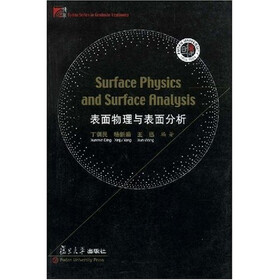
| 丁训民,1946年7月出生于上海。1970年毕业于复旦大学物理系,留校任教至今。其间曾以访问学者身份去德国、日本、瑞典、香港等国家和地区工作,现为复旦大学物理系教授。主要从事表面物理等课程的教学和半导体表面与界面等方面的研究,已在国内外学术刊物上发表论文一百多篇,撰写过《同步辐射应用概论》和《论表面分析及其在材料研究中的应用》中的部分章节。因在用电子能谱方法研究半导体表面的物理和化学特性方面作出贡献,荣获2003年上海市科技进步一等奖。 杨新菊,1966年11月出生于浙江。1988年毕业于复旦大学物理系,1994年在复旦大学材料科学系获得博士学位,留校任教至今。现为复旦大学物理系副教授,从事表面物理的教学和科研工作,以及硅基低维材料的制备及性质研究。 王迅,1934年4月生于上海。1960年1月复旦大学研究生毕业。1984年起任复旦大学教授,1996年起任复旦大学首席教授。1999年当选为中国科学院院士。现从事半导体物理、表面和界面物理,以及硅基低维量子体系的研究。 |
| PREFACE Chapter1 Introduction 1.1 Characteristics of Surface 1.1.1 Unique Characteristics of Surface 1.1.2 The Subjects of Surface Physics 1.2 Methodology of Surface Science 1.2.1 General Idea 1.2.2 Category of Surface analyticalTechnologies 1.3 Electron Spectroscopy 1.3.1 Energy Distribution of Secondary Electrons 1.3.2 Mean Free Path and Surface Sensitivity 1.4 Surface Cleaning Processes 1.4.1 Clean Surface versusNative Surface 1.4.2 Methods of Preparing Clean Surfaces Chapter2 Surface Atomics tructures 2.1 Two Dimensional Crystallography 2.1.1 Periodicity and Symmetry of Surface Unit Cell 2.1.2 PointGroup and Plane Group 2.1.3 Nomenclature of Surface Structures 2.1.4 Reciprocal Lattice 2.2 Atomic Structures of Ideal Surfaces 2.2.1 Surface Structures of Metals 2.2.2 Surfaces of Crystalline Compounds and Alloys 2.3 Surface Relaxation and Reconstruction 2.3.1 Surface Relaxation 2.3.2 Surface reconstruction 2.4 Surface Defects 2.4.1 PointDefects 2.4.2 Dislocations 2.4.3 Atomic Steps Chapter3 Low Energy Electron Diffraction and Reflection High Energy Electron Diffraction 3.1 Principles 3.1.1 Brief of the Diffraction in Three Dimensions 3.1.2 Electron Diffraction in Two Dimensions 3.2 Apparatus 3.2.1 LEED Optics 3.2.2 Spot Profile Analysis LEED 3.2.3 Measurement of I-V Curves 3.2.4 Shield and Compensation of Stray Electromagnetic Field 3.3 Pattern Recognition 3.3.1 Diffraction Orders 3.3.2 Pattern Transform 3.3.3 LEED Patterns of Stepped Surfaces 3.4 LEED I-V 3.4.1 Experimental and Theoretical I-V Curves 3.4.2 R Factor 3.5 Reflection High Energy Electron Diffraction 3.5.1 Principle 3.5.2 RHEED Analysis 3.5.3 RHEED Intensity Oscillation 3.6 Appendix 3.6.1 Compilation of LEED Patterns 3.6.2 Compilation of RHEED Patterns Chapter4 Scanning Probe Microscopy 4.1 General Concept 4.2 Scanning Tunneling Microscopy 4.2.1 Basic Principle 4.2.2 Apparatus 4.2.3 WorkingModes and Conditions 4.2.4 STM Imaging 4.2.5 Scanning Tunneling Spectroscopy 4.2.6 STM Nanofabrication and Atom Manipulation 4.3 Atom ic ForceMicroscopy 4.3.1 Principle 4.3.2 Apparatus 4.3.3 WorkingModes of AFM 4.3.4 Lateral Force Microscopy 4.4 Other Types of Scanning Probe Microscopy 4.4.1 Scanning Magnetic Force Microscopy 4.4.2 Scanning Near-field Optical Microscopy 4.4.3 Ballistic Electron Emission Microscopy Chapter5 Surface Electronic States 5.1 Existence of Localized Electronic States at Surfaces 5.1.1 Bulk States and Surface States 5.1.2 Surface States in One-dimensional Models 5.2 Surface Dangling Bond States 5.2.1 Dangling Bond and Its Hybrid 5.2.2 Dangling Bond States at Reconstructed Surfaces 5.2.3 Dangling Bond States and Fermi Level Pinning 5.3 Adsorbate Induced Electronic States 5.3.1 Adsorption Phenomena 5.3.2 Adsorbate-induced Work Function Changes 5.3.3 Metal-induced Gap States(MIGS) Chapter6 Auger Electron Spectroscopy 6.1 Principle 6.1.1 Auger Process 6.1.2 Energy of Auger Electron 6.1.3 Yield and Cross-section 6.1.4 Differential Spectra and Count Spectra 6.2 Apparatus and Experimental Methods 6.2.1 Experimental Setup 6.2.2 Experimental Conditions 6.3 Qualitative and Quantitative Analysis 6.3.1 Element Identification 6.3.2 Quantitative Composition Analysis 6.3.3 Chemical Analysis 6.4 Depth Profiling 6.4.1 Purpose and Methods 6.4.2 Profile of Compositions 6.4.3 Interface Location 198 6.5 Scanning Auger Microscopy 6.5.1 Line-scan 6.5.2 Auger Map 6.5.3 Spatial Resolution Chapter7 X-ray Photoelectron Spectroscopy 7.1 Principle 7.1.1 Three Step Process of Photoemission 7.1.2 Binding Energy 7.2 Apparatus 7.2.1 X-ray Sources 7.2.2 Electron Energy Analyzer 7.2.3 Detectors 7.3 Qualitative Analysis 7.3.1 Energy Calibration 7.3.2 Peak Discrimination 7.3.3 Element Identification 7.4 Quantitative Analysis 7.4.1 Quantification Methods 7.4.2 Background Subtraction 7.4.3 Peak Decomposition 7.4.4 Depth Profile and Depth Information 7.5 Chemical States Studies 7.5.1 Chemical Shift 7.5.2 Charging Effect and Compensation 7.6 Appendix-Electron binding energies of elements in periodic table Chapter8 Ultra-Violet Photoelectron Spectroscopy 8.1 Principle 8.1.1 UPS versus XPS 8.1.2 Basic Process 8.1.3 Selection Rules and Wavefunction Symmetry 8.2 Light Sources 8.2.1 Discharge Lamp 8.2.2 Monochromator and Polarizer 8.2.3 Special Synchrotron Radiation Sources 8.3 Applications 8.3.1 Identification of Surface Electronic States 8.3.2 Mapping of Surface and Bulk Bands 8.3.3 Identification of Adsorbates:Species and Adsorption Sites References |




 内容加载中,请稍后...



商品评论(0条)