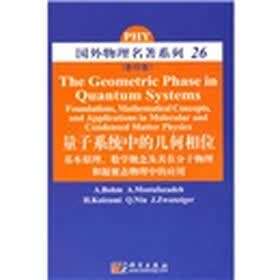
| 1 Introduction 2 Quantal Phase Factors for Adiabatic Changes 2.1 Introduction 2.2 Adiabatic Approximation 2.3 Berrys Adiabatic Phase 2.4 Topological Phases and the Aharonov-Bohm Effect Problems 3 Spinning Quantum System in an External Magnetic Field 3.1 Introduction 3.2 The Parameterization of the Basis Vectors 3.3 Mead-Berry Connection and Berry Phase for Adiabatic Evolutions - Magnetic Monopole Potentials 3.4 The Exact Solution of the SchrSdinger Equation 3.5 Dynamical and Geometrical Phase Factors for Non-Adiabatic Evolution Problems 4 Quantal Phases for General Cyclic Evolution 4.1 Introduction 4.2 Aharonov-Anandan Phase 4.3 Exact Cyclic Evolution for Periodic Hamiltonians Problems 5 Fiber Bundles and Gauge Theories 5.1 Introduction 5.2 From Quantal Phases to Fiber Bundles 5.3 An Elementary Introduction to Fiber Bundles 5.4 Geometry of Principal Bundles and the Concept of Holonomy 5.5 Gauge Theories 5.6 Mathematical Foundations of Gauge Theories and Geometry of Vector Bundles Problems 6 Mathematical Structure of the Geometric Phase I: The Abelian Phase 6.1 Introduction 6.2 Holonomy Interpretations of the Geometric Phase 6.3 Classification of U(1) Principal Bundles and the Relation Between the Berry-Simon and Aharonov-Anandan Interpretations of the Adiabatic Phase 6.4 Holonomy Interpretation of the Non-Adiabatic Phase Using a Bundle over the Parameter Space 6.5 Spinning Quantum System and Topological Aspects of the Geometric Phase Problems 7 Mathematical Structure of the Geometric Phase II: The Non-Abelian Phase 7.1 Introduction 7.2 The Non-Abelian Adiabatic Phase 7.3 The Non-Abelian Geometric Phase 7.4 Holonomy Interpretations of the Non-Abelian Phase 7.5 Classification of U(N) Principal Bundles and the Relation Between the Berry-Simon and Aharonov-Anandan Interpretations of Non-Abelian Phase Problems 8 A Quantum Physical System in a Quantum Environment - The Gauge Theory of Molecular Physics 8.1 Introduction 8.2 The Hamiltonian of Molecular Systems 8.3 The Born-Oppenheimer Method 8.4 The Gauge Theory of Molecular Physics 8.5 The Electronic States of Diatomic Molecule 8.6 The Monopole of the Diatomic Molecule Problems 9 Crossing of Potential Energy Surfaces and the Molecular Aharonov-Bohm Effect 9.1 Introduction 9.2 Crossing of Potential Energy Surfaces 9.3 Conical Intersections and Sign-Change of Wave Functions 9.4 Conical Intersections in Jahn-Teller Systems 9.5 Symmetry Of the Ground State in Jahn-Teller Systems 9.6 Geometric Phase in Two Kramers Doublet Systems 9.7 Adiabatic-Diabatic Transformation 10. Experimental Detection of Geometric Phases I Quantum Systems in Classical Environments 10.1 Introduction 10.2 The Spin Berry Phase Controlled by Magnetic Fields 10.2.1 Spins in Magnetic Fields: The Laboratory Frame 10.2.2 Spins in Magnetic Fields: The Rotating Frame 10.2.3 Adiabatic Reorientation in Zero Field 10.3 Observation of the Aharonov-Anandan Phase Through the Cyclic Evolution of Quantum States Problems 11.Experimental Detection of Geometric Phases II: Quantum Systems in Quantum Environments 11.1 Introduction 11.2 Internal Rotors Coupled to External Rotors 11,3 Electronic-Rotational Coupling 11.4 Vibronic Problems in Jahn-Teller Systems 11.4.1 Transition Metal Ions in Crystals 11.4.2 Hydrocarbon Radicals 11.4.3 Alkali Metal Trimers 11.5 The Geometric Phase in Chemical Reactions 12.Geometric Phase in Condensed Matter I: Bloch Bands 12.1 Introduction 12.2 Bloch Theory 12.2.1 One-Dimensional Case 12.2.2 Three-Dimensional Case 12.2.3 Band Structure Calculation 12.3 Semiclassical Dynamics 12.3.1 Equations of Motion 12.3.2 Symmetry Analysis 12.3.3 Derivation of the Semiclassical Formulas 12.3.4 Time-Dependent Bands 12.4 Applications of Semiclassical Dynamics 12.4.1 Uniform DC Electric Field 12.4.2 Uniform and Constant Magnetic Field 12.4.3 Per 12.5.1 General Properties 12.5.2 Localization Properties 12.6 Some Issues on Band Insulators 12.6.1 Quantized Adiabatic Particle Transport 12.6.2 Polarization Problems 13. Geometric Phase in Condensed Matter II:The Quantum Hall Effect 13.1 Introduction 13.2 Basics of the Quantum Hall Effect 13.2.1 The Halt Effect 13.2.2 The Quantum Hall Effect 13.2.3 The Ideal Model 13.2.4 Corrections to Quantization 13.3 Magnetic Bands in Periodic Potentials 13.3.1 Single-Band Approximation in a Weak Magnetic Field 13.3.2 Harpers Equation and Hofstadters Butterfly 13.3.3 Magnetic Translations 13.3.4 Quantized Hall Conductivity 13.3.5 Evaluation of the Chern Number 13.3.6 Semiclassical Dynamics and Quantization 13.3.7 Structure of Magnetic Bands and Hyperorbit Levels 13.3.8 Hierarchical Structure of the Butterfly 13.3.9 Quantization of Hyperorbits and Rule of Band Splitting 13.4 Quantization of Hall Conductance in Disordered Systems 13.4.1 Spectrum and Wave Functions 13.4.2 Perturbation and Scattering Theory 13.4.3 Laughlins Gauge Argument 13.4.4 Hall Conductance as a Topological Invariant 14. Geometric Phase in Condensed Matter III:Many-Body Systems 14.1 Introduction 14.2 Fractional Quantum Hall Systems 14.2.1 Laughlin Wave Function 14.2.2 Fractional Charged Excitations 14.2.3 Fractional Statistics 14.2.4 Degeneracy and Fractional Quantization 14.3 Spin-Wave Dynamics in Itinerant Magnets 14.3.1 General Formulation 14.3.2 Tight-Binding Limit and Beyond 14.3.3 Spin Wave Spectrum 14.4 Geometric Phase in Doubly-Degenerate Electronic Bands Problem A.An Elementary Introduction to Manifolds and Lie Groups A.1 Introduction A.2 Differentiable Manifolds A.3 Lie Groups B. A Brief Review of Point Groups of Molecules with A |




 内容加载中,请稍后...




商品评论(0条)