In this anthology of reminiscences by prominent scientists,
the roll includes Richard Dawkins, Murray Gell-Mann, Joseph Ledoux
and Ray Kurzweil, along with 23 others. The mandate of the book's
editor, literary agent Brockman (The Third Culture), to each of
these authors was to write an essay explaining how he or she came
to be a scientist. Some take him at his word and write meandering
stories of childhood. David Buss found his calling—the study of
human mating behavior—while working at a truck stop after dropping
out of school. Paul Davies says he was born to be a theoretical
physicist. Daniel Dennett, on the other hand, seems to have tried
every other profession before landing, as if by accident, in
science. A few writers let their essays get hijacked by the science
they have devoted their lives to. And in the midst of this, like a
keystone in an arch, is an essay by Steven Pinker explaining why
the entire exercise is a bunch of hooey: scientifically speaking,
he says, people have no objective idea what influenced their
behavior, and that writing a memoir is creative storytelling, not
objective observation of what actually happened. Whether or not
these essays are scientifically sound is open to debate, but they
do offer occasionally inspiring glimpses into the minds of today's
scientific intelligentsia.
Copyright © Reed Business Information, a division of Reed
Elsevier Inc. All rights reserved. --This text refers to the
Hardcover edition.
From Scientific American
When the late evolutionist and polymath Stephen Jay Gould was a
toddler, he became fascinated and terrified by the towering
Tyrannosaurus rex skeleton at the American Museum of Natural
History. Gould later claimed to have been instantly "imprinted" on
the monstrous saurian, like a duckling on its mama. The little boy
decided on the spot to become a paleontologist--years before he
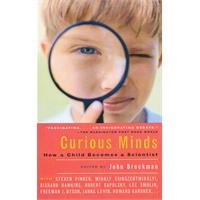
even learned the word. In John Brockman's Curious Minds: How a
Child Becomes a Scientist, a collection of 27 autobiographical
essays by leading savants, Harvard psychologist Steven Pinker
scoffs at this oft-told story. Pinker relates that Gould dedicated
his first book: "For my father, who took me to see the
Tyrannosaurus when I was five," and admires Gould's "genius ... for
coming up with that charming line." But he doesn't buy it. Pinker
goes on to tell his own childhood story, with the caveat that
long-term memory is notoriously malleable and that we often concoct
retrospective scenarios to fit satisfying scripts of our lives. So
don't believe anything in this book, he warns, including his own
self-constructed mythology; many children are exposed to books and
museums, but few become scientists. Pinker concludes that perhaps
the essence of who we are from birth shapes our childhood
experiences rather than the other way around. Nevertheless, when
Brockman asked Pinker and others to trace the roots of their adult
obsessions for this book, he received some unexpected and
entertaining responses. Primatologist Robert Sapolsky, for example,
haunted the Bronx Zoo and the natural history museum, as Gould did,
but fell in love with living primates rather than fossil bones. He
didn't want to just study mountain gorillas, he recalls of his
childhood crush on monkeys and apes, "I wanted to be one." For the
past few decades, Sapolsky has spent half of each year in his
physiology lab and the other half among wild baboon troops in East
Africa. Some people, such as theoretical psychologist Nicholas
Humphrey, are simply born into science. His grandfather, Nobel
laureate A. V. Hill, often took him along to the physiology lab.
Grandfather Hill--quoting his friend Ivan Pavlov--taught young
Nicholas that "facts are the air of a scientist. Without them you
can never fly." Among frequent visitors to the family home were his
great-uncles Maynard and Geoffrey Keynes, members of British
science's aristocracy, as well as his great-aunt Margaret, a
granddaughter of Charles Darwin. He recalls how their long-term
houseguest, an adolescent, "bossy" Stephen Hawking, once marched up
and down the hallways clutching a military swagger stick, barking
at a "platoon of hapless classmates." Science was Humphrey's
birthright. Richard (The Selfish Gene) Dawkins, one of England's
preeminent Darwinians, admits that he never cared for science or
the natural world during his early years. He was inspired, however,
by the fanciful children's books about Dr. Dolittle by Hugh
Lofting. The good doctor was a Victorian gentleman who held
intelligent conversations with mice and parrots and whales. An
adventurous sort, he traveled the world to learn the secrets of
faraway places. When the adult Dawkins encountered the life and
works of Charles Darwin, he welcomed him as an old friend and hero
of his youth. Dolittle and Darwin, he opines, "would have been soul
brothers." Lynn Margulis's early interest in the wonders of the
microscopic world began when she was a "boy crazy" adolescent, who
was amazed to learn that some minuscule creatures never need sex in
order to reproduce. Enter a teenage heartthrob: the budding
astrophysicist Carl Sagan. ("Tall, handsome in a sort of galooty
way, with a shock of brown-black hair, he captivated me.") She was
16 when they met; eventually they married. Sagan's fascination with
"billions and billions" of cosmic bodies resonated with her own
fixation on the billions of microcosms to be observed through the
microscope. Margulis's study subjects have included a tiny animal
in a termite's gut that is made up of five distinct genomes cobbled
together. She has argued that we and other animals are composite
critters, whose every cell harbors long-ago invaders--minute
symbiotic organisms that became part of our makeup. Her innovative
approach to evolution has profoundly influenced biology. Harvard
psychologist and neurologist Howard Gardner says his youth was
notable for its lack of any clues indicating a future in science:
"I did not go around gathering flowers, studying bugs, or
dissecting mice ... I neither assembled radios nor tore apart
cars." Yet, for others, there was a decisive turning point. And
some could clearly remember it. I was fortunate in having been a
childhood friend of Steve Gould's and can vouch for the sincerity o
f his conviction that his extraordinary career as a paleontologist,
historian of science and evolutionary theorist began when that T.
rex followed him into his nightmares. Once, during our junior high
school days, I stood with him beneath that iconic carnosaur in the
museum, observing his reverence and awe on revisiting the shrine of
his inspiration. Professor Pinker, of course, is free to believe
that I'm making this up for my own psychological reasons.
|



 内容加载中,请稍后...


商品评论(0条)