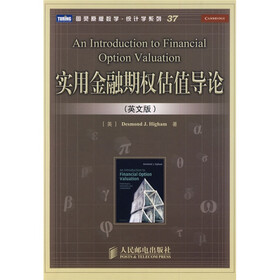
| 《实用金融期权估值导论(英文版)》借助Matlab阐述了期权定价理论的入门知识,讲述隐藏在期权评估背后的数学、随机指数和计算算法。仔细推导了基本的资产价格模型和Black-Scholes公式,并阐述了相关的计算技术,包括二项式、有限差分、Monte CarIo方法的方差缩减技术。 生动流畅的文字、丰富的图表、大量的示例以及基于实际证券市场数据的计算,使得这《实用金融期权估值导论(英文版)》非常实用,深受好评。《实用金融期权估值导论(英文版)》自成体系,只需要具有微积分知识背景就可阅读,不需要概率、统计或数值分析的基础。每章末都给出了Matlab例程及练习题,便于读者学习体会。 |
| Desmond J.Higham,英国Strathclyde大学数学系教授,SIAM会士、爱丁堡数学会会士、伦敦数学会会士。主要研究数值分析和随机计算,包括随机计算在数理金融中的应用。Higham是很多期刊的编委,如SLAM Journal on Scientific Computing、the IMA Journal of Numerical Analysis和the Journal of Computational Finance等。另有著作Learning LaTeX和Matlab Guide。 |
| 1 Options 1.1 What are options? 1.2 Why do we study options? 1.3 How are options traded? 1.4 Typical option prices 1.5 Other financial derivatives 1.6 Notes and references 1.7 Program of Chapter 1 and walkthrough 2 Option valuation preliminaries 2.1 Motivation 2.2 Interest rates 2.3 Short selling 2.4 Arbitrage 2.5 Put-call parity 2.6 Upper and lower bounds on option values 2.7 Notes and references 2.8 Program of Chapter 2 and walkthrough 3 Random variables 3.1 Motivation 3.2 Random variables, probability and mean 3.3 Independence 3.4 Variance 3.5 Normal distribution 3.6 Central Limit Theorem 3.7 Notes and references 3.8 Program of Chapter 3 and walkthrough 4 Computer simulation 4.1 Motivation 4.2 Pseudo-random numbers 4.3 Statistical tests 4.4 Notes and references 4.5 Program of Chapter 4 and walkthrough 5 Asset price movement 5.1 Motivation 5.2 Efficient market hypothesis 5.3 Asset price data 5.4 Assumptions 5.5 Notes and references 5.6 Program of Chapter 5 and walkthrough 6 Asset price model: Part I 6.1 Motivation 6.2 Discrete asset model 6.3 Continuous asset model 6.4 Lognormal distribution 6.5 Features of the asset model 6.6 Notes and references 6.7 Program of Chapter 6 and walkthrough 7 Asset price model: PartⅡ 7.1 Computing asset paths 7.2 Timescale invariance 7.3 Sum-of-square returns 7.4 Notes and references 7.5 Program of Chapter 7 and walkthrough 8 Black-Scholes PDE and formulas 8.1 Motivation 8.2 Sum-of-square increments for asset price 8.3 Hedging 8.4 Black-Scholes PDE 8.5 Black-Scholes formulas 8.6 Notes and references 8.7 Program of Chapter 8 and walkthrough 9 More on hedging 9.1 Motivation 9.2 Discrete hedging 9.3 Delta at expiry 9.4 Large-scale test 9.5 Long-Term Capital Management 9.6 Notes 9.7 Program of Chapter 9 and walkthrough 10 The Greeks 10.1 Motivation 10.2 The Greeks 10.3 Interpreting the Greeks 10.4 Black-Scholes PDE solution 10.5 Notes and references 10.6 Program of Chapter 10 and walkthrough 11 More on the Black-Scholes formulas 11.1 Motivation 11.2 Where is μ? 11.3 Time dependency 11.4 The big picture 11.5 Change of variables 11.6 Notes and references 11.7 Program of Chapter 11 and walkthrough 12 Risk neutrality 12.1 Motivation 12.2 Expected payoff 12.3 Risk neutrality 12.4 Notes and references 12.5 Program of Chapter 12 and walkthrough 13 Solving a nonlinear equation 13.1 Motivation 13.2 General problem 13.3 Bisection 13.4 Newton 13.5 Further practical issues 13.6 Notes and references 13.7 Program of Chapter 13 and walkthrough 14 Implied volatility 14.1 Motivation 14.2 Implied volatility 14.3 Option value as a function of volatility 14.4 Bisection and Newton 14.5 Implied volatility with real data 14.6 Notes and references 14.7 Program of Chapter 14 and walkthrough 15 Monte Carlo method 15.1 Motivation 15.2 Monte Carlo 15.3 Monte Carlo for option valuation 15.4 Monte Carlo for Greeks 15.5 Notes and references 15.6 Program of Chapter 15 and walkthrough 16 Binomial method 16.1 Motivation 16.2 Method 16.3 Deriving the parameters 16.4 Binomial method in practice 16.5 Notes and references 16.6 Program of Chapter 16 and walkthrough 17 Cash-or-nothing options 17.1 Motivation 17.2 Cash-or-nothing options 17.3 Black-Scholes for cash-or-nothing options 17.4 Delta behaviour 17.5 Risk neutrality for cash-or-nothing options 17.6 Notes and references 17.7 Program of Chapter 17 and walkthrough 18 American options 18.1 Motivation 18.2 American call and put 18.3 Black-Scholes for American options 18.4 Binomial method for an American put 18.5 Optimal exercise boundary 18.6 Monte Carlo for an American put 18.7 Notes and references 18.8 Program of Chapter 18 and walkthrough 19 Exotic options 19.1 Motivation 19.2 Barrier options 19.3 Lookback options 19.4 Asian options 19.5 Bermudan and shout options 19.6 Monte Carlo and binomial for exotics 19.7 Notes and references 19.8 Program of Chapter 19 and walkthrough 20 Historical volatility 20.1 Motivation 20.2 Monte Carlo-type estimates 20.3 Accuracy of the sample variance estimate 20.4 Maximum likelihood estimate 20.5 Other volatility estimates 20.6 Example with real data 20.7 Notes and references 20.8 Program of Chapter 20 and walkthrough 21 Monte Carlo Part II: variance reduction by antithetic variates 21.1 Motivation 21.2 The big picture 21.3 Dependence 21.4 Antithetic variates: uniform example 21.5 Analysis of the uniform case 21.6 Normal case 21.7 Multivariate case 21.8 Antithetic variates in option valuation 21.9 Notes and references 21.10 Program of Chapter 21 and walkthrough 22 Monte Carlo Part III: variance reduction by control variates 22.1 Motivation 22.2 Control variates 22.3 Control variates in option valuation 22.4 Notes and references 22.5 Program of Chapter 22 and walkthrough 23 Finite difference methods 23.1 Motivation 23.2 Finite difference operators 23.3 Heat equation 23.4 Discretization 23.5 FTCS and BTCS 23.6 Local accuracy 23.7 Von Neumann stability and convergence 23.8 Crank-Nicolson 23.9 Notes and references 23.10 Program of Chapter 23 and walkthrough 24 Finite difference methods for the Black-Scholes PDE 24.1 Motivation 24.2 FTCS, BTCS and Crank-Nicolson for Black-Scholes 24.3 Down-and-out call example 24.4 Binomial method as finite differences 24.5 Notes and references 24.6 Program of Chapter 24 and walkthrough References Index |


 内容加载中,请稍后...




商品评论(0条)