网上购物 货比三家
您现在的位置:快乐比价网 > 图书 > 文学 > 网络文学 > 商品详情

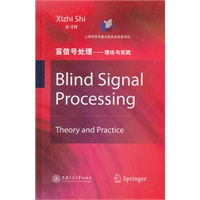
盲信号处理——理论与实践(英文版)

分享到:
盲信号处理——理论与实践(英文版)

最 低 价:¥99.20

定 价:¥150.00

作 者:史习智 等编著

出 版 社:上海交通大学出版社

出版时间:2011-1-1

I S B N:9787313058201

价格
99.20元
价格
118.50元
价格
118.50元
价格
127.50元

商品详情

编辑推荐

        肓信号处理是现代数学信号处理、计算智能学近年来迅速发展的重要方向,在电子信息、通信、生物医学、图像增强、雷达、地球物理信号处理等众多领域有广泛的应用前景。史习智编著的这本《盲信号处理——理论与实践》较系统地介绍了盲信号处理的基本理论、数学描述、独立分量分析、非线性PCA、非线性ICA、卷积混合和盲解卷积、盲信号处理的扩展、数据分析和应用研究等。本书可作为作为高年级本科生、研究生的教材,也可作为电子信息、通信、图像处理、遥感、雷达、生物医学信号处理、地震、语言信号处理等相关领域科技人员的参考书。

内容简介

    Blind Signal Processing Theory and Practice not only introduces related fundamental mathematics, but also reflects the numerous advances in the field, such as probability density estimation-based processing algorithms,underdetermined models, complex value methods, uncertainty of order in the separation of convolutive mixtures in frequency domains, and feature extraction using Independent Component Analysis (ICA). At the end of the book, results from a study conducted at Shanghai Jiao Tong University in the areas of speech signal processing, underwater signals, image feature extraction, data compression, and the like are discussed.
    This book will be of particular interest to advanced undergraduate students,graduate students, university instructors and research scientists in related disciplines. Xizhi Shi is a Professor at Shanghai Jiao Tong University.

作者简介

目录

Chapter 1  Introduction
  1.1  Introduction
  1.2  Blind Source Separation
  1.3  Independent Component Analysis (ICA)
  1.4  The Historical Development and Research Prospect of Blind Signal Processing
  References
Chapter 2  Mathematical Description of Blind Signal Processing
  2.1  Random Process and Probability Distribution
  2.2  Estimation Theory
  2.3  Information Theory
  2.4  Higher-Order Statistics
  2.5  Preprocessing of Signal
  2.6  Complex Nonlinear Function
  2.7  Evaluation Index
  References
Chapter 3  Independent Component Analysis
  3.1  Problem Statement and Assumptions
  3.2  Contrast Functions
  3.3  Information Maximization Method of ICA
  3.4  Maximum Likelihood Method and Common Learning Rule
  3.5  FastICA Algorithm
  3.6  Natural Gradient Method
  3.7  Hidden Markov Independent Component Analysis
  References
Chapter 4  Nonlinear PCA & Feature Extraction
  4.1  Principal Component Analysis & Infinitesimal Analysis
  4.2  Nonlinear PCA and Blind Source Separation
  4.3  Kernel PCA
  4.4  Neural Networks Method of Nonlinear PCA and Nonlinear Complex PCA
  References
Chapter 5  Nonlinear ICA
  5.1  Nonlinear Model and Source Separation
  5.2  Learning Algorithm
  5.3  Extended Gaussianization Method of Post Nonlinear Blind Separation
  5.4  Neural Network Method for Nonlinear ICA
  5.5  Genetic Algorithm of Nonlinear ICA Solution
  5.6  Application Examples of Nonlinear ICA
  References
Chapter 6  Convolutive Mixtures and Blind Deconvolution
  6.1  Description of Issues
  6.2  Convolutive Mixtures in Time-Domain
  6.3  Convolutive Mixtures Algorithms in Frequency-Domain
  6.4  Frequency-Domain Blind Separation of Speech Convolutive Mixtures
  6.5  Bussgang Method
  6.6  Multi-channel Blind Deconvolution
  References
Chapter 7  Blind Processing Algorithm Based on Probability Density Estimation
  7.1  Advancing the Problem
  7.2  Nonparametric Estimation of Probability Density Function
  7.3  Estimation of Evaluation Function
  7.4  Blind Separation Algorithm Based on Probability Density Estimation
  7.5  Probability Density Estimation of Gaussian Mixtures Model
  7.6  Blind Deconvolution Algorithm Based on Probability Density Function Estimation
  7.7  On-line Algorithm of Nonparametric Density Estimation
  References
Chapter 8  Joint Approximate Diagonalization Method
  8.1  Introduction
  8.2  JAD Algorithm of Frequency-Domain Feature
  8.3  JAD Algorithm of Time-Frequency Feature
  8.4  Joint Approximate Block Diagonalization Algorithm of Convolutive Mixtures
  8.5  JAD Method Based on Cayley Transformation
  8.6  Joint Diagonalization and Joint Non-Diagonalization Method
  8.7  Nonparametric Density Estimating Separating Method Based on Time-Frequency Analysis
  References
Chapter 9  Extension of Blind Signal Processing
  9.1  Blind Signal Extraction
  9.2  From Projection Pursuit Technology to Nonparametric Density Estimation-Based ICA
  9.3  Second-Order Statistics Based Convolutive Mixtures Separation Algorithm
  9.4  Blind Separation for Fewer Sensors than Sources--Underdetermined Model
  9.5  FastlCA Separation Algorithm of Complex Numbers in Convolutive Mixtures
  9.6  On-line Complex ICA Algorithm Based on Uncorrelated Characteristics of Complex Vectors
  9.7  ICA-Based Wigner-Ville Distribution
  9.8  ICA Feature Extraction
  9.9  Constrained ICA
  9.10 Particle Filtering Based Nonlinear and Noisy ICA
  References
Chapter 10  Data Analysis and Application Study
  10.1  Target Enhancement in Active Sonar Detection
  10.2  ECG Artifacts Rejection in EEG with ICA
  10.3  Experiment on Underdetermined Blind Separation of A Speech Signal
  10.4  ICA in Human Face Recognition
  10.5  ICAin Data Compression
  10.6  Independent Component Analysis for Functional MRI Data Analysis
  10.7  Speech Separation for Automatic Speech Recognition System
  10.8  Independent Component Analysis of Microarray Gene Expression Data in the Study of Alzheimer's Disease (AD)
  References
Index

商品评论(0条)

暂无评论!

您的浏览历史

loading 内容加载中,请稍后...
