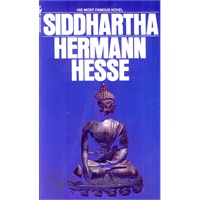
In the shade of a banyan tree, a grizzled ferryman sits listening to the river. Some say he's a sage. He was once a wandering shramana and, briefly, like thousands of others, he followed Gotama the Buddha, enraptured by his sermons. But this man, Siddhartha, was not a follower of any but his own soul. Born the son of a Brahmin, Siddhartha was blessed in appearance, intelligence, and charisma. In order to find meaning in life, he discarded his promising future for the life of a wandering ascetic. Still, true happiness evaded him. Then a life of pleasure and titillation merely eroded away his spiritual gains until he was just like all the other "child people," dragged around by his desires. Like Hermann Hesse's other creations of struggling young men, Siddhartha has a good dose of European angst and stubborn individualism. His final epiphany challenges both the Buddhist and the Hindu ideals of enlightenment. Neither a practitioner nor a devotee, neither meditating nor reciting, Siddhartha comes to blend in with the world, resonating with the rhythms of nature, bending the reader's ear down to hear answers from the river. In this translation Sherab Chodzin Kohn captures the slow, spare lyricism of Siddhartha's search, putting her version on par with Hilda Rosner's standard edition. --Brian Bruya --This text refers to the Paperback edition. From Library Journal Review Review |
Hermann Hesse was born in 1877 in Calw, Germany. He won the Nobel Prize for Literature in 1946. He is the author of Steppenwolf, Narcissus and Goldmund, Journey to the East, The Glass Bead Game, and many other books. Sherab Ch?dzin Kohn has translated numerous books of spiritual and psychological interest from German and other European languages. He was a close student of Tibetan meditation master Ch?gyam Trungpa and is the author of The Awakened One: A Life of the Buddha. --This text refers to an out of print or unavailable edition of this title. |




 内容加载中,请稍后...



商品评论(0条)