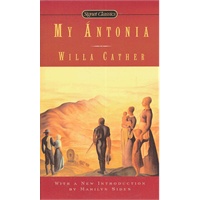
It seems almost sacrilege to infringe upon a book as soulful and
rich as Willa Cather's My ?ntonia by offering comment. First
published in 1918, and set in Nebraska in the late 19th century,
this tale of the spirited daughter of a Bohemian immigrant family
planning to farm on the untamed land ("not a country at all but the
material out of which countries are made") comes to us through the
romantic eyes of Jim Burden. He is, at the time of their meeting,
newly orphaned and arriving at his grandparents' neighboring farm
on the same night her family strikes out to make good in their new
country. Jim chooses the opening words of his recollections
deliberately: "I first heard of ?ntonia on what seemed to be an
interminable journey across the great midland plain of North
America," and it seems almost certain that readers of Cather's
masterpiece will just as easily pinpoint the first time they heard
of ?ntonia and her world. It seems equally certain that they, too,
will remember that moment as one of great light in an otherwise
unremarkable trip through the world. As if all this humanity weren't enough, Cather paints her descriptions of the vastness of nature--the high, red grass, the road that "ran about like a wild thing," the endless wind on the plains--with strokes so vivid as to make us feel in our bones that we've just come in from a walk on that very terrain ourselves. As the story progresses, Jim goes off to the University in Lincoln to study Latin (later moving on to Harvard and eventually staying put on the East Coast in another neat encompassing of a stage in America's development) and learns Virgil's phrase "Optima dies ... prima fugit" that Cather uses as the novel's epigraph. "The best days are the first to flee"--this could be said equally of childhood and the earliest hours of this country in which the open land, much like My ?ntonia, was nothing short of a rhapsody in prairie sky blue. --Melanie Rehak --This text refers to an alternate Paperback edition.
|
Willa Cather (1873-1947) was born in Virginia and raised on the Nebraska prairie.She worked as a newspaper writer, teacher, and managing editor of McClure's magazine.In addition to My ?ntonia, her books include O Pioneers! (1913) and The Professor's House. She was awarded the Pulitzer Prize in 1923 for One of Ours. --This text refers to an out of print or unavailable edition of this title. |
Introduction by Marilyn Sides |





 内容加载中,请稍后...



商品评论(0条)