Review
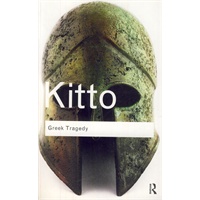
'Two things give Kitto's classic book its enduring freshness: he
pioneered the approach to Greek drama through internal artistry and
thematic form, and he always wrote in lively and readable English.'
- Oliver Taplin, University of Oxford, UK
Product Description
With a new foreword by Edith Hall
'Two things give Kitto's classic book its enduring freshness: he
pioneered the approach to Greek drama through internal artistry and
thematic form, and he always wrote in lively and readable English.'
- Oliver Taplin, University of Oxford, UK
Why did Aeschylus characterize differently from Sophocles? Why
did Sophocles introduce the third actor? Why did Euripides not make
better plots? So asks H.D.F Kitto in his acclaimed study of Greek
tragedy, available for the first time in Routledge Classics.
Kitto argues that in spite of dealing with big moral and
intellectual questions, the Greek dramatist is above all an artist
and the key to understanding classical Greek drama is to try and
understand the tragic conception of each play. In Kitto’s words ‘We
shall ask what the dramatist is striving to say, not what in fact
he does say about this or that.’ Through a brilliant analysis of
Aeschylus’s ‘Oresteia’, the plays of Sophocles including ‘Antigone’
and ‘Oedipus Tyrannus’; and Euripides’s ‘Medea’ and ‘Hecuba’, Kitto
skilfully conveys the enduring artistic and literary brilliance of
the Greek dramatists.
H.D.F Kitto (1897 – 1982) was a renowned British classical
scholar. He lectured at the University of Glasgow from 1920-1944
before becoming Professor of Greek at Bristol University, where he
taught until 1962.
|
 内容加载中,请稍后...






商品评论(0条)