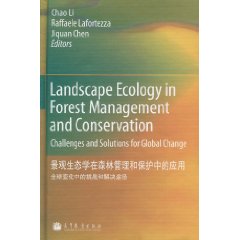

| 《景观生态学在森林管理和保护中的应用:全球变化中的挑战和解决途径(国内英文版)》由高等教育出版社出版。 |
| 编者:(加拿大)李超 (意大利)拉福尔泰扎 (美国)陈吉泉李超,Dr. Chao Li is a Research Scientist with the Canadian Forest Service (CFS),Natural Resources Canada, and leads the Landscape Disturbances andForest Valuation Modeling group. Dr. Raffaele Lafortezza is a Lecturer intorest landscape eco ogy at the University of Bari, Italy, Dr. Jiquan Chen isa Professor at the Department of Environmental Sciences, the University ofToledo, USA. |
| Pars I Landscape Ecology and Forest ManagementChapter 1 Managing Forest Landscapes under Global Change Scenarios1.1 Introduction1.2 Forest management1.3 New challenges in a changing globe1.4 Landscape ecology contributions1.5 Conclusion remarksReferencesChapter 2 Landscape Ecology Contributions to Forestry and Forest Management in China: Progresses and Research Needs2.1 Introduction2.2 China's forestry and forest management2.3 Challenges and emerging global issues in forestry2.4 Contributions of landscape ecology to forest management and conservation2.5 Research needs for forest landscape management2.6 Concluding remarksAcknowledgementsReferencesChapter 3 Issues Facing Forest Management in Canada, and Predictive Ecosystem Management Tools for Assessing Possible Futures3.1 A brief history of forestry in Canada3.2 Canada's lands and forests3.3 Issues facing forestry in Canada today3.4 How can Canadian forestry respond to these and other issues?One way is ecosystem management modeling3.5 ConclusionsReferencesPart Ⅱ Modeling Disturbance and Succession in Forest LandscapesChapter 4 Challenges and Needs in Fire Management: A Landscape Simulation Modeling Perspective4.1 Introduction4.2 Simulation modeling in fire management4.3 Technical challenges in fire management modeling4.4 A fire management simulation example4.5 Research and management needs and solutions4.6 SummaryReferencesChapter 5 Using Landscape Disturbance and Succession Models to Support Forest Management5.1 Introduction5.2 Overview of landscape disturbance and succession models5.3 Case studies5.4 General conclusions5.5 Future of LDSMs in decision-makingAcknowledgementsReferencesChapter 6 Research Methods for Assessing the Impacts of Forest Disturbance on Hydrology at Large-scale Watersheds6.1 Introduction6.2 Definition of large-scale watersheds6.3 Quantification of forest disturbance6.4 Research methods on assessing impacts of forest disturbance on hydrology at large-scale watersheds6.5 Future directions6.6 ConclusionsAcknowledgementsReferencesChapter 7 Software Applications to Three-Dimensional Visualization of Forest Landscapes —— A Case Study Demonstrating the Use of Visual Nature Studio (VNS) in Visualizing Fire Spread in Forest Landscapes7.1 Introduction7.2 Forest landscape visualization7.3 Results and discussion7.4 Conclusion7.5 Future wildfire visualization researchAcknowledgementsReferencesChapter 8 Predicting Tree Growth Dynamics of Boreal Forest in Response to Climate Change8.1 Introduction8.2 Materials and methods8.3 Results8.4 Discussion8.5 ConclusionsAcknowledgementsReferencesPart III Emerging Approaches in Forest Landscape ConservationChapter 9 The Next Frontier: Projecting the Effectiveness of Broad-scale Forest Conservation Strategies9.1 Introduction9.2 Template project: Wild Rivers Legacy Forest and Two Hearted River Watershed9.3 Conclusions and implications: Pushing the frontierReferencesChapter 10 Forest Avian Species Richness Distribution and Management Guidelines under Global Change in Mediterranean Landscapes10.1 Introduction10.2 Material and methods10.3 Results and discussion10.4 Concluding remarks and forest management guidelinesAcknowledgementsReferencesChapter 11 Development of a Forest Network System to Improve the Zoning Process: A Case Study in Japan11.1 Background of the Japanese forest policy and methodological problems11.2 State of the public participation11.3 How to improve the current zoning process11.4 On the effective use of social backgrounds and evaluation11.5 Experts vs. the general public11.6 Perspectives of the futureReferences Part Ⅳ Practicing Sustainable Forest Landscape ManagementIndex |





 内容加载中,请稍后...







商品评论(0条)