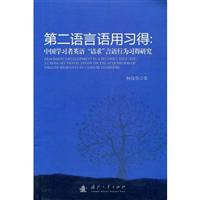
| 《第2语言语用习得:中国学习者英语请求语言行为习得研究》是在作者的博士论文基础上修改而成的。在中介语语用学(Interlanguage:Pragmatics)理论指导下,研究母语为汉语的学习者英语语用能力习得的特点和规律以及影响二语语用习得的因素。 |
| Chapter One Introduction.1.1 Research background1.2 Significance of the present study1.3 Organization of the bookChapter Two Acquisitional Issues in Interlanguage Pragmatics2.1 Pragmatic competence2.1.1 Communicative competence2.1.2 A working definition of pragmatic competence2.2 The definition and scope of Intedanguage Pragmatics (ILP)2.3 The theoretical perspectives of L2 pragmatic acquisition2.3.1 Cognitive processing2.3.2 Relevance theory (RT)2.3.3 The complexification hypothesis2.4 Factors influencing L2 pragmatic acquisition2.4.1 Classroom instruction2.4.2 Pragmatic transfer2.4.3 Grammatical competence2.5 Methodology in doing acquisitional research2.5.1 Developmental research designs2.5.2 Data collection instruments2.6 SummaryChapter Three Studies on the Speech Act of Requests3.1 Definition and taxonomy of requests3.1.1 Defining requests3.1.2 A taxonomy of requests3.2 Illocutionary aspects of requests3.2.1 Request strategies3.2.2 Internal modification (1M)3.2.3 External modification (EM)3.3 Studies on the speech act of requests3.3.1 Cross-cultural research on requests3.3.2 Developmental research on requests3.3.3 Studies on requests by Chinese researchers3.4 SummaryChapter Four Research Design4.1 Research questions4.2 Informants4.2.1 Criteria in selecting informants4.2.2 Learner informants4.2.3 Native informants4.3 Research instruments4.3.1 Background questionnaire4.3.2 Developing request scenarios..4.3.3 The production questionnaire and sociopragmatic assessment questionnaire4.4 Data collection4.5 Data analysis framework4.5.1 Request strategies4.5.2 Internal modification4.5.3 External modification4.5.4 Procedures of data analysis4.6 SummaryChapter Five Data Analysis and Discussion5.1 Request strategies5.1.1 Total number of strategies5.1.2 Directness5.1.3 Conventional indirectness5.1.4 Non-conventional indirectness (Hints)5.1.5 Combination of individual strategies5.1.6 Opting out5.1.7 Summary and discussion of request strategies5.2 Internal modification5.2.1 Overall per[ormanee of internal modification5.2.2 Syntactic downgraders5.2.3 Lexical/phrasal downgraders5.2.4 Upgraders5.2.5 Combination of IM5.2.6 ZerolM5.2.7 Summary and discussion of internal modification5.3 External modification5.3.1 Overall performance of supportive moves5.3.2 Employment of supportive moves by situation5.3.3 Summary and discussion of external modification5.4 Situational variation in requesting behavior5.4.1 Sociopragrnatic assessment questionnaire5.4.2 Assessment of social parameters across groups5.4.3 Assessment of social parameters across situations5.4.4 Perception of social parameters and choice of request strategies5.4.5 Summary and discussion of sociopragmatic competence5.5 The effect of L1 pragmatic transfer on L2 request acquisition5.5.1 Request strategies and L1 influence5.5.2 lntenal modification and L1 influence5.5.3 External modification and L1 influence5.5.4 Summary of transfer effect5.6 Summary: Overall developmental features of English requestsChapter Six The Role of Instruction in [2 Pragmatic Development6.1 Negative effect of instruct}on on 1_2 pragmatic development6.1.1 Metapragmatic input6.1.2 Classroom discourse6.1.3 Grammar-oriented Pedagogy6 2 Need for instruction of L2 pragmatics6.2.1 Curricula6.2.2 Teaching materials6.2.3 Instruction of L2 speech acts6.3 SummaryChapter Seven Conclusion7.1 Summary of findings7.2 Factors influencing L2 pragmatic development7.3 Limitations of the present study and directions for future researchReferencesAppendix 1 Questionnaire for Chinese learnersAppendix 2 Questionnaire for Chinese native speakersAppendix 3 Qnestiomnaire for English native speakers... |

 内容加载中,请稍后...





商品评论(0条)