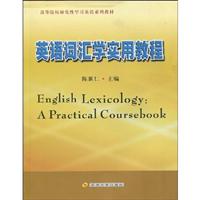
| 《英语词汇学实用教程》:高等院校研究性学习英语系列教材 |
| Unit1 Preliminaries about LexicologyPre-Class Reading1.1 Lexicology as a branch of linguistic study1.2 The vocabulary of a language1.3 Words as main units of the English vocabulary1.4 Lexical knowledge1.5 Lexical competenceIn-Class ActivitiesPost-Class TasksProiect WorkUnit2 The Formation of English WordsPre-Class Reading 2.1 Morphemes in English 2.2 Major processes of word formation in English2.3 Other processes of word formation in EnglishIn-Class Activities Post-Class Tasks Project Work Unit3 The Grammatical Aspect of English WordsPre-Class Reading3.1 Word classes in English3.2 Countable nouns vs. uncountable nouns3.3 Transitive verbs vs. intransitive verbs3.4 Dynamic verbs vs. stative verbsIn-Class ActivitiesPost-Class TasksProject WorkUnit4 The Idiomatic Aspect of English Word CombinationsPre-Class Reading4.1 Chunks in English4.2 Collocations in English 4.3 Idioms in English4.4 Proverbs in EnglishIn-Class ActivitiesPost-Class TasksProject WorkUnit5 The Semantic Tgpes of English WordsPre-Class Reading5.1 Concrete words vs. abstract words5.2 Proper nouns vs. common nouns5.3 Descriptive words vs. evaluative words5.4 Fuzzy words and hedgesIn-Class ActivitiesPost-Class TasksProiect WorkUnit6 The Semantic Networks of English WordsPre-Class Reading6.1 Semantic networks6.2 Semantic fields6.3 Superordinates vs. hyponyms 6.4 Meronyms vs. holonyms6.5 Lexical gapsIn-Class ActivitiesPost-Class TasksProject WorkUnit7 The Semantic Relations among English WordsPre-Class Reading7.1 Synonyms and synonymous expressions7.2 Antonyms and antonymous expressions7.3 Polysemous words vs. homonymous words7.4 Semantic relations and textual organizationIn-Class ActivitiesPost-Class TasksProject WorkUnit8 The Emotional Aspect of English WordsPre-Class Reading8.1 Appreciative words VS.derogatory words8.2 Semantic prosody of some words 8.3 Other lexical devices to convey affeetIn-Class ActivitiesPost-Class TasksProject WorkUnit9 The Stglistic Aspect of English WordsPre-Class Reading9.1 Style and formality9.2 Genre and vocabulary9.3 Technical terms in EnglishIn-Class Activities Post-Class TasksProject WorkUnit10 The Social Aspect of English WordsPre-Class Reading10.1 Gender and English words 10.2 Honorifics in English10.3 Euphemisms in EnglistlIn-Class Activities Post-Class TasksProject WorkUnit11 The Cultural Aspect of English WordsPre-Class Reading11.1 Color terms an(1 culture11.2 Numerals and culture11.3 Euphemisms and culture 11.4 Idioms and cultureIn-Class Activities Post-Class TasksProject WorkUnit12 The Cognitive Aspect of English WordsPro-Class Reading12.1 Literal and figurative use of vocabulary12.2 Metaphoric mechanism in the English vocabulary12.3 Metonymic mechanism in the English vocabulary12.4 English discourse markersIn-Class Activities Post-Class TasksProiect WorkUnit13 The Change of English WordsPre-Class Reading13.1 Semantic change of English words13.2 Morphological change of English words13.3 Grammatical change of English words13.4 Cyber vocabulary 13.5 Catchy words in EnglishIn-Class Activities Post-Class TasksProiect WorkUnit14 The Loan Words in EnglishPre-Class Reading14.1 Words borrowed from Latin and Greek14.2 Words borrowed from French14.3 Words borrowed from other Indo-European languages 14.4 Words borrowed from Chinese and Japanese14.5 Nativization of English words in ChinaIn-Class Activities Post-Class TasksProiect WorkUnit15 Learning the English VocabularyUnit16 The Tgpes and Components of DictionariesReferencesGlossary |

 内容加载中,请稍后...




商品评论(0条)