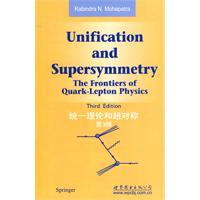
| 《统一理论和超对称(第3版)》是由世界图书出版公司出版的。 |
| 作者:(美国)莫哈帕特拉(Rabindra N.Mohapatra) |
| preface to the third edition preface to the second edition preface to the first edition 1 important basic concepts in particle physics 1.1 introduction 1.2 symmetries and currents 1.3 local symmetries and yang-mills fields 1.4 quantum chromodynamic theory of strong interactions 1.5 hidden symmetries of weak interactions references 2 spontaneous symmetry breaking 2.1 symmetries and their realizations 2.2 nambu-goldstone bosons for an arbitrary non-abelian group 2.3 some properties of nambu-goldstone bosons 2.4 phenomenology of massless and near-massless spin-0 bosons 2.5 the higgs-kibble mechanism in gauge theories 2.6 group theory of the higgs phenomenon 2.7 renormalizability and triangle anomalies references 3 the su(2)l x u(1) model 3.1 the su(2)l x u(1) model of glashow, weinberg, and salam 3.2 neutral-current interactions 3.3 masses and decay properties of w and z bosons 3.4 fermion masses and mixing 3.5 higher-order-induced flavor-changing neutral-current effects 3.6 the higgs bosons 3.7 su(2)l x u(1) model with two higgs doublets 3.8 puzzles of the standard model 3.9 outline of the various scenarios 3.10 beyond the standard model references 4 cp violation: weak and strong 4.1 cp violation in weak interactions 4.2 cp violation in gauge models: generalities 4.3 the kobayashi-maskawa model 4.4 left-right symmetric models of cp violation 4.5 the higgs exchange models 4.6 strong cp violation and the 0-problem 4.7 solutions to the strong cp problem without the axion 4.8 summary references 5 grand unification and the su(5) model 5.1 the hypothesis of grand unification 5.2 su(n) grand unification 5.3 sin2 ow in grand unified theories (gut) 5.4 su(5) 5.5 grand unification mass scale and sin2θw at low energies 5.6 detailed predictions of the su(5) model for proton decay 5.7 some other aspects of the su(5) model 5.8 gauge coupling unification with intermediate scales before grand unification references 6 symmetric models of weak interactions and massive neutrinos 6.1 why left-right symmetry? 6.2 the model, symmetry breaking, and gauge boson masses 6.3 limits on mzr and rnwr from charged-current weak interactions 6.4 properties of neutrinos and lepton-number-violating processes 6.5 baryon number nonconservation and higher unification 6.6 sin2θw and the scale of partial unification 6.7 left-right symmetry--an alternative formulation 6.8 higher order effects 6.9 conclusions references 7 so(10) grand unification 7.1 introduction 7.2 so(2n) in an su(n) basis [3] 7.3 fermion masses and the "charge conjugation" operator 7.4 symmetry-breaking patterns and intermediate mass scales 7.5 decoupling parity and su(2)r breaking scales 7.6 second z' boson references 8 technicolor and compositeness 8.1 why compositeness? 8.2 technicolor and electroweak symmetry breaking 8.3 techni-composite pseudo-goldstone bosons 8.4 fermion masses 8.5 composite quarks and leptons 8.6 light quarks and leptons and 't hooft anomaly matching 8.7 examples of 't hooft anomaly matching 8.8 some dynamical constraints on composite models 8.9 other aspects of composite models 8.10 symmetry breaking via top-quark condensate references 9 global supersymmetry 9.1 supersymmetry 9.2 a supersymmetric field theory 9.3 two-component notation 9.4 superfields 9.5 vector and chiral superfields references 10 field theories with global supersymmetry 10.1 supersymmetry action 10.2 supersymmetric gauge invariant lagrangian 10.3 feynman rules for supersymmetric theories [3] 10.4 allowed soft-breaking terms references 11 broken supersymmetry and application to particle physics 11.1 spontaneous breaking of supersymmetry 11.2 supersymmetric analog of the goldberger treiman relation 11.3 d-type breaking of supersymmetry 11.4 o'raifeartaigh mechanism or f-type breaking of supersymmetry 11.5 a mass formula for supersymmetric theories and the need for soft breaking references 12 minimal supersymmetric standard model 12.1 introduction, field content and the lagrangian 12.2 constraints on the masses of superparticles 12.3 other effects of superparticles 12.4 why go beyond the mssm? 12.5 mechanisms for supersymmetry breaking 12.6 renormalization of soft supersymmetry-breaking parameters 12.7 supersymmetric left-right model references 13 supersymmetric grand unification 14 local supersymmetry (n= 1) 15 application of supergravity (n= 1) to particle physics 16 beyond n= 1 supergravity 17 superstrings and quark-lepton physics index |



 内容加载中,请稍后...





商品评论(0条)